


Page 415 - 9780077418427.pdf
P. 415
/Users/user-f465/Desktop
          tiL12214_ch15_377-404.indd Page 392  9/3/10  6:17 PM user-f465
          tiL12214_ch15_377-404.indd Page 392  9/3/10  6:17 PM user-f465                                                /Users/user-f465/Desktop


                                                                          ing star” is a meteor. Most meteors burn up or evaporate com-
                                                                          pletely within seconds after reaching an altitude of about 100 km
                                                                          (about 60 mi) because they are nothing more than specks of dust.
                                                                          A meteor shower occurs when Earth passes through a stream of
                                                                          particles left by a comet in its orbit. Earth might meet the stream
                                                                          of particles concentrated in such an orbit on a regular basis as
                                                                          it travels around the Sun, resulting in predictable meteor show-
                                                                          ers (Table 15.5). In the third week of October, for example, Earth
                                                                          crosses the orbital path of Halley’s comet, resulting in a shower of
                                                                          some 10 to 15 meteors per hour. Meteor showers are named for
                                                                          the constellation in which they appear to originate. The October
                                                                          meteor shower resulting from an encounter with the orbit of Hal-
                                                                          ley’s comet, for example, is called the Orionid shower because it
                                                                          appears to come from the constellation Orion.
                                                                             Did you know that atom-bomb-sized meteoroid explosions
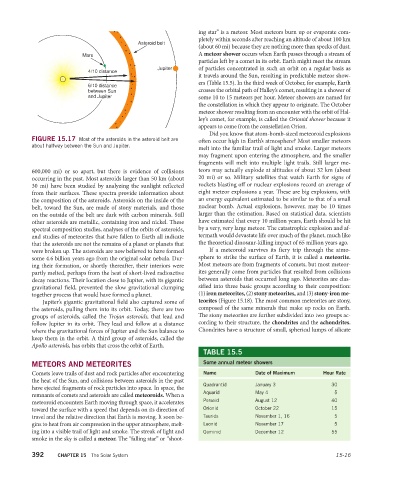
                   FIGURE 15.17  Most of the asteroids in the asteroid belt are   often occur high in Earth’s atmosphere? Most smaller  meteors
                   about halfway between the Sun and Jupiter.
                                                                          melt into the familiar trail of light and smoke. Larger meteors
                                                                          may fragment upon entering the atmosphere, and the smaller
                                                                          fragments will melt into multiple light trails. Still larger me-
                   600,000 mi) or so apart, but there is evidence of collisions   teors may actually explode at altitudes of about 32 km (about
                   occur ring in the past. Most asteroids larger than 50 km (about   20 mi) or so. Military satellites that watch Earth for signs of
                   30 mi) have been studied by analyzing the sunlight reflected   rockets blasting off or nuclear explosions record an average of
                   from their surfaces. These spectra provide information about   eight meteor explosions a year. These are big explosions, with
                   the composition of the asteroids. Asteroids on the inside of the   an energy equivalent estimated to be similar to that of a small
                   belt, toward the Sun, are made of stony materials, and those   nuclear bomb. Actual explosions, however, may be 10 times
                   on the outside of the belt are dark with carbon minerals. Still   larger than the estimation. Based on statistical data, scientists
                   other asteroids are metallic, containing iron and nickel. These   have estimated that every 10 million years, Earth should be hit
                   spectral composition studies, analyses of the orbits of asteroids,   by a very, very large meteor. The catastrophic explosion and af-
                   and studies of meteorites that have fallen to Earth all indicate   termath would dev astate life over much of the planet, much like
                   that the asteroids are not the remains of a planet or planets that   the  theoretical  dinosaur-killing impact of 65 million years ago.
                   were broken up. The asteroids are now believed to have formed   If a meteoroid survives its fiery trip through the atmo-
                   some 4.6 billion years ago from the original solar nebula. Dur-  sphere to strike the surface of Earth, it is called a meteorite.
                   ing their formation, or shortly thereafter, their interiors were   Most  meteors are from fragments of comets, but most meteor-
                   partly melted, perhaps from the heat of short-lived  radioactive   ites generally come from particles that resulted from collisions
                   decay reactions. Their location close to Jupiter, with its gigantic   between asteroids that occurred long ago. Meteorites are clas-
                   gravitational field, prevented the slow gravitational clumping   sified into three basic groups according to their composition:
                   together process that would have formed a planet.      (1) iron meteorites, (2) stony meteorites, and (3) stony-iron me-
                      Jupiter’s gigantic gravitational field also captured some of   teorites (Figure 15.18). The most common meteorites are stony,
                   the asteroids, pulling them into its orbit. Today, there are two   composed of the same minerals that make up rocks on Earth.
                   groups of asteroids, called the Trojan asteroids, that lead and   The stony meteorites are further subdivided into two groups ac-
                     follow Jupiter in its orbit. They lead and follow at a distance   cording to their structure, the chondrites and the achondrites.
                   where the gravitational forces of Jupiter and the Sun balance to   Chondrites have a structure of small, spherical lumps of silicate
                   keep them in the orbit. A third group of asteroids, called the
                   Apollo asteroids, has orbits that cross the orbit of Earth.
                                                                           TABLE 15.5
                   METEORS AND METEORITES                                  Some annual meteor showers
                   Comets leave trails of dust and rock particles after encountering   Name  Date of Maximum       Hour Rate
                   the heat of the Sun, and collisions between asteroids in the past
                                                                           Quadrantid        January 3                30
                   have ejected fragments of rock particles into space. In space, the
                                                                           Aquarid           May 4                     5
                   remnants of comets and asteroids are called meteoroids. When a
                   meteoroid encounters Earth moving through space, it accelerates   Perseid  August 12               40
                   toward the surface with a speed that depends on its direction of   Orionid  October 22             15
                   travel and the relative direction that Earth is moving. It soon be-  Taurids   November 1, 16        5
                   gins to heat from air compression in the upper atmo sphere, melt-  Leonid  November 17              5
                   ing into a visible trail of light and smoke. The streak of light and   Geminid  December 12        55
                   smoke in the sky is called a meteor. The “falling star” or “shoot-

                   392     CHAPTER 15  The Solar System                                                                15-16

