


Page 417 - 9780077418427.pdf
P. 417
/Users/user-f465/Desktop
          tiL12214_ch15_377-404.indd Page 394  9/3/10  6:17 PM user-f465
          tiL12214_ch15_377-404.indd Page 394  9/3/10  6:17 PM user-f465                                                /Users/user-f465/Desktop


                                                                          the protoplanet Mars was forming compared to where the proto-
                                                                            planet Earth was forming. Evidence for this part of the model
                                                                          is found in Mars today, with its greater abundance of iron. It is
                                                                          the abundant iron oxides that make Mars the red planet.
                                                                             All of the protoplanets might have started out somewhat
                                                                          similarly as huge accumulations of a slushy mixture with an
                        A
                                                                            atmosphere of hydrogen and helium gases. Gravitational at-
                                                                          traction must have compressed the protoplanets as well as the
                                                                            protosun. During this period of contraction and heating, gravi-
                                                                          tational adjustments continued, and about one-fifth of the disk
                       B
                                                                          nearest to the protosun must have been pulled into the central
                                                                          body of the protosun, leaving a larger accumulation of matter in
                                                                          the outer part of the accretion disk.

                        C
                                                                          STAGE C
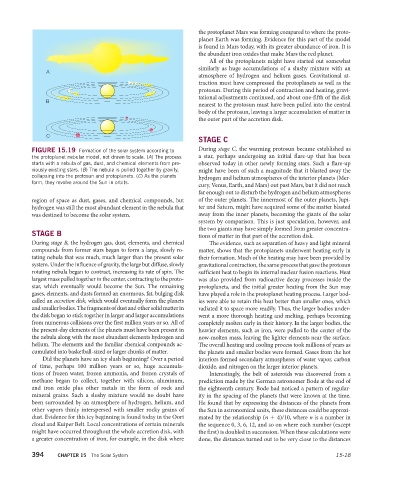
                   FIGURE 15.19  Formation of the solar system according to   During stage C, the warming protosun became established as
                   the protoplanet nebular model, not drawn to scale. (A) The process   a star, perhaps undergoing an initial flare-up that has been
                   starts with a nebula of gas, dust, and chemical elements from pre-  observed today in other newly forming stars. Such a flare-up
                   viously existing stars. (B) The nebula is pulled together by gravity,   might have been of such a magnitude that it blasted away the
                   collapsing into the protosun and protoplanets. (C) As the planets   hydrogen and helium atmospheres of the interior planets (Mer-
                   form, they revolve around the Sun in orbits.
                                                                          cury, Venus, Earth, and Mars) out past Mars, but it did not reach
                                                                          far enough out to disturb the hydrogen and helium atmospheres
                   region of space as dust, gases, and chemical compounds, but   of the outer planets. The innermost of the outer planets, Jupi-
                   hydrogen was still the most abundant element in the nebula that   ter and Saturn, might have acquired some of the matter blasted
                   was destined to become the solar system.               away from the inner planets, becoming the giants of the solar
                                                                          system by comparison. This is just speculation, however, and
                                                                          the two giants may have simply formed from greater concentra-
                   STAGE B                                                tions of matter in that part of the accretion disk.
                   During stage B, the hydrogen gas, dust, elements, and chemical   The evidence, such as separation of heavy and light mineral
                   compounds from former stars began to form a large, slowly ro-  matter, shows that the protoplanets underwent heating early in
                   tating nebula that was much, much larger than the present solar   their formation. Much of the heating may have been provided by
                   system. Under the influence of gravity, the large but diffuse, slowly   gravitational contraction, the same process that gave the proto sun
                   rotating nebula began to contract, increasing its rate of spin. The   sufficient heat to begin its internal nuclear fusion reactions. Heat
                   largest mass pulled together in the center, contracting to the proto -  was also provided from radioactive decay processes inside the
                   star, which eventually would become the Sun. The remaining  protoplanets, and the initial greater heating from the Sun may
                   gases, elements, and dusts formed an enormous, fat, bulging disk   have played a role in the protoplanet heating process. Larger bod-
                   called an accretion disk, which would eventually form the planets   ies were able to retain this heat better than smaller ones, which
                   and smaller bodies. The fragments of dust and other solid matter in   radiated it to space more readily. Thus, the larger bodies under-
                   the disk began to stick together in larger and larger accumulations   went a more thorough heating and melting, perhaps becoming
                   from numerous collisions over the first million years or so. All of   completely molten early in their history. In the larger bodies, the
                   the present-day elements of the planets must have been present in   heavier elements, such as iron, were pulled to the center of the
                   the nebula along with the most abundant  elements hydrogen and   now-molten mass, leaving the lighter elements near the surface.
                   helium. The elements and the familiar chemical compounds ac-  The overall heating and cooling process took millions of years as
                   cumulated into basketball-sized or larger chunks of matter.  the planets and smaller bodies were formed. Gases from the hot
                      Did the planets have an icy slush beginning? Over a  period   interiors formed secondary atmospheres of water vapor, carbon
                   of time, perhaps 100 million years or so, huge accumula-  dioxide, and nitrogen on the larger interior planets.
                   tions of frozen water, frozen ammonia, and frozen crystals of   Interestingly, the belt of asteroids was discovered from a
                   methane began to collect, together with silicon, aluminum,   prediction made by the German astronomer Bode at the end of
                   and iron oxide plus other metals in the form of rock and   the eighteenth century. Bode had noticed a pattern of regular-
                   mineral grains. Such a slushy mixture would no doubt have   ity in the spacing of the planets that were known at the time.
                   been surrounded by an atmosphere of hydrogen, helium, and   He found that by expressing the distances of the planets from
                   other vapors thinly interspersed with smaller rocky grains of   the Sun in astronomical units, these distances could be approxi-
                   dust. Evidence for this icy beginning is found today in the Oort   mated by the relationship (n + 4)/10, where n is a number in
                   cloud and Kuiper Belt. Local concentrations of certain minerals   the sequence 0, 3, 6, 12, and so on where each number (except
                   might have occurred throughout the whole accretion disk, with   the first) is doubled in succession. When these calculations were
                   a greater concentration of iron, for example, in the disk where   done, the distances turned out to be very close to the distances

                   394     CHAPTER 15  The Solar System                                                                15-18

