


Page 492 - 9780077418427.pdf
P. 492
/Users/user-f465/Desktop
          tiL12214_ch18_455-476.indd Page 469  9/3/10  6:21 PM user-f465
          tiL12214_ch18_455-476.indd Page 469  9/3/10  6:21 PM user-f465                                                /Users/user-f465/Desktop


                                                                     People Behind the Science


                                                                                Harry Hammond Hess (1906–1969)

                              arry Hess was the U.S. geologist who                              1962 the notion of deep-sea  spreading. This
                          Hplayed the key part in the plate tecton-                             contended that convection within Earth
                          ics revolution of the 1960s.                                          was continually creating new ocean floor at
                             Born in New York, Hess first studied elec-                         mid-ocean ridges. Material, Hess claimed,
                          trical engineering and then trained in geol-                          was incessantly rising from Earth’s mantle
                          ogy at Yale and later Princeton universities.                         to create the mid-ocean ridges, which then
                          From 1931, he began geophysical researches                            flowed horizontally to constitute new oce-
                          into the oceans, accompanying F. A. Vening                            anic crust. It would follow that the farther
                            Meinesz on a Caribbean submarine expedi-                            from the mid-ocean ridge, the older would
                          tion to measure gravity and take soundings.                           be the crust—an expectation confirmed by
                          During World War II, Hess continued his                               research in 1963 by D. H. Matthews and his
                          oceanographic investigations, undertaking                             student F. J. Vine into the magnetic anoma-
                          extended echo-soundings while  captain of the                         lies of the seafloor. Hess envisioned that
                          assault transport USS Cape Johnson.  During                           the process of seafloor spreading would
                          the war years, he made studies of the flat-                           continue as far as the continental margins,
                          topped sea mounts that he called guyots (after                        where the oceanic crust would slide down
                          Arnold Guyot, an earlier Princeton geolo-                             beneath the lighter continental crust into a
                          gist). In the postwar years, he was one of the                        subduction zone, the  entire operation thus
                          main advocates of the  Mohole project, whose                          constituting a kind of terrestrial conveyor
                          aim was to drill down through Earth’s crust to                        belt. Within a few years, the plate tectonics
                          gain access to the upper mantle.                                      revolution that Hess spearheaded had proved
                             The vast increase in seabed knowledge                              entirely successful. Hess’s role in this “revo-
                          (deriving in part from wartime naval activi-  Building on Maurice Ewing’s discovery of the   lution in the earth sciences” was largely due
                          ties) led to the recognition that certain parts   global distribution of mid-ocean ridges and   to his remarkable breadth as geophysicist,
                          of the ocean floor were anomalously young.   their central rift valleys, Hess enunciated in   geologist, and oceanographer.


                        Source: From the Hutchinson Dictionary of Scientific Biography. © Research Machines plc 2003. All Rights Reserved. Helicon Publishing is a division of Research Machines.


                           Another proposed mechanism of plate motion is called   the slab may also be increased by loss of water and  reforming of
                       slab-pull (Figure 18.20). In this mechanism, the sub ducting plate   minerals into denser forms.
                       is colder and therefore denser than the sur rounding hot mantle,   What is generally accepted about the plate tectonic the-
                       so it pulls the surface part of the plate downward. Density of   ory is the understanding that the solid materials of Earth


                                                                                                   Trench
                                               Ridge


                                                                                        Lithosphere
                                             80 to 100 km
                                                                               Asthenosphere

                                                                                                                            ?
                                                                  Plate slides downhill
                                                                    on this surface


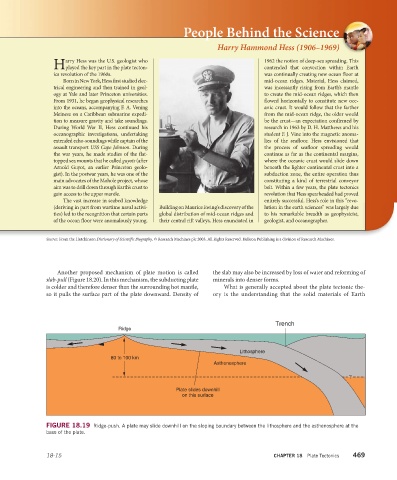
                       FIGURE 18.19  Ridge-push. A plate may slide downhill on the sloping boundary between the lithosphere and the asthenosphere at the
                       base of the plate.


                       18-15                                                                       CHAPTER 18  Plate Tectonics   469

