


Page 487 - 9780077418427.pdf
P. 487
/Users/user-f465/Desktop
          tiL12214_ch18_455-476.indd Page 464  9/3/10  6:21 PM user-f465
          tiL12214_ch18_455-476.indd Page 464  9/3/10  6:21 PM user-f465                                                /Users/user-f465/Desktop


                                                                          Divergent Boundaries
                                                                          Divergent boundaries occur between two plates moving away
                                                                          from each other. Magma forms as the plates separate, decreas-
                                                                          ing pressure on the mantle below. This molten material from the
                                                                          asthenosphere rises, cools, and adds new crust to the edges of
                                                                          the separating plates. The new crust tends to move horizontally
                                                                          from both sides of the divergent boundary, usually known as an
                                                                          oceanic ridge. A divergent boundary is thus a new crust zone.
                                                                          Most new crust zones are presently on the seafloor, producing
                                                                          seafloor spreading (Figure 18.14).
                                                                             The Mid-Atlantic Ridge is a divergent boundary between
                                                                          the South American and African Plates, extending north  between
                                                                          the North American and Eurasian Plates (see  Figure 18.13). This
                                                                          ridge is one segment of the global mid-ocean ridge system
                                                                          that encircles Earth. The results of divergent plate movement
                                                                          can be seen in Iceland, where the Mid-Atlantic Ridge runs as
                                                                          it separates the North American and Eurasian Plates. In the
                                                                          northeastern part of Iceland, ground cracks are widening, often
                                                                          accompanied by volcanic activity. The movement was measured
                                                                          extensively between 1975 and 1984, when displacements caused
                                                                          a total separation of about 7 m (about 23 ft).
                                                                             The measured rate of spreading along the Mid-Atlantic Ridge
                                                                          ranges from 1 to 6 cm per year. This may seem slow, but the pro-
                                                                          cess has been going on for millions of years and has caused a tiny
                                                                          inlet of water between the continents of  Europe, Africa, and the
                                                                          Americas to grow into the vast Atlantic Ocean that exists today.
                                                                             Another major ocean may be in the making in East Africa,
                                                                          where a divergent boundary has already moved Saudi Arabia
                                                                          away from the African continent, forming the Red Sea. If this
                                                                          spreading between the African Plate and the Arabian Plate con-
                                                                          tinues, the Indian Ocean will flood the area and the easternmost
                                                                          corner of Africa will become a large island.


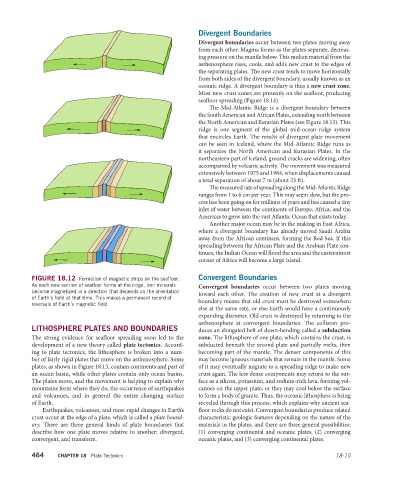
                   FIGURE 18.12  Formation of magnetic strips on the seafloor.   Convergent Boundaries
                   As each new section of seafloor forms at the ridge, iron minerals   Convergent boundaries occur between two plates moving
                   become magnetized in a direction that depends on the orientation   toward each other. The creation of new crust at a divergent
                   of Earth’s field at that time. This makes a permanent record of
                   reversals of Earth’s magnetic field.                   boundary means that old crust must be destroyed somewhere
                                                                          else at the same rate, or else Earth would have a continuously
                                                                          expanding diameter. Old crust is destroyed by returning to the
                                                                          asthenosphere at convergent  boundaries. The collision pro-
                   LITHOSPHERE PLATES AND BOUNDARIES                      duces an elongated belt of down-bending called a subduction
                   The strong evidence for seafloor spreading soon led to the   zone. The lithosphere of one plate, which contains the crust, is
                   development of a new theory called plate tectonics. Accord-  subducted beneath the second plate and partially melts, then
                   ing to plate tectonics, the lithosphere is broken into a num-  becoming part of the mantle. The denser components of this
                   ber of fairly rigid plates that move on the asthenosphere. Some   may become igneous materials that remain in the mantle. Some
                   plates, as shown in Figure 18.13, contain continents and part of   of it may eventually migrate to a spreading ridge to make new
                   an ocean basin, while other plates contain only ocean basins.   crust again. The less dense components may return to the sur-
                   The plates move, and the movement is helping to explain why   face as a silicon, potassium, and sodium-rich lava, forming vol-
                   mountains form where they do, the occurrence of earthquakes   canoes on the upper plate; or they may cool below the surface
                   and volcanoes, and in general the entire changing surface   to form a body of granite. Thus, the oceanic lithosphere is being
                   of Earth.                                              recycled through this process, which explains why  ancient sea-
                      Earthquakes, volcanoes, and most rapid changes in Earth’s   floor rocks do not exist. Convergent boundaries  produce related
                   crust occur at the edge of a plate, which is called a plate bound-  characteristic geologic features depending on the nature of the
                   ary. There are three general kinds of plate boundaries that   materials in the plates, and there are three general possibilities:
                   describe how one plate moves relative to another: divergent,   (1) converging continental and oceanic plates, (2) converging
                   convergent, and transform.                             oceanic plates, and (3) converging continental plates.

                   464     CHAPTER 18 Plate Tectonics                                                                  18-10

