


Page 490 - 9780077418427.pdf
P. 490
/Users/user-f465/Desktop
tiL12214_ch18_455-476.indd Page 467 9/3/10 6:21 PM user-f465
tiL12214_ch18_455-476.indd Page 467 9/3/10 6:21 PM user-f465 /Users/user-f465/Desktop
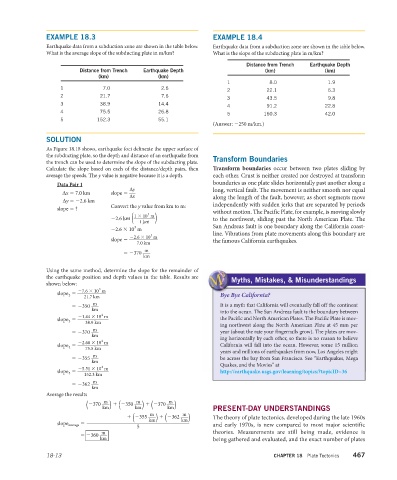
EXAMPLE 18.3 EXAMPLE 18.4
Earthquake data from a subduction zone are shown in the table below. Earthquake data from a subduction zone are shown in the table below.
What is the average slope of the subducting plate in m/km? What is the slope of the subducting plate in m/km?
Distance from Trench Earthquake Depth
Distance from Trench Earthquake Depth (km) (km)
(km) (km)
1 8.0 1.9
1 7.0 2.6
2 22.1 6.3
2 21.7 7.6
3 43.5 9.8
3 38.9 14.4
4 91.2 22.8
4 75.5 26.8
5 160.3 42.0
5 152.3 55.1
(Answer: −250 m/km.)
SOLUTION
As Figure 18.18 shows, earthquake foci delineate the upper surface of
the subducting plate, so the depth and distance of an earthquake from Transform Boundaries
the trench can be used to determine the slope of the subducting plate.
Calculate the slope based on each of the distance/depth pairs, then Transform boundaries occur between two plates sliding by
average the speeds. The y value is negative because it is a depth. each other. Crust is neither created nor destroyed at transform
Data Pair 1 boundaries as one plate slides horizontally past another along a
Δy
_ long, vertical fault. The movement is neither smooth nor equal
Δx = 7.0 km slope =
Δx along the length of the fault, however, as short segments move
Δy = −2.6 km
Convert the y value from km to m: independently with sudden jerks that are separated by periods
slope = ? without motion. The Pacific Plate, for example, is moving slowly
3
_ )
1 × 1 0 m
−2.6 km ( to the northwest, sliding past the North American Plate. The
1 km
3
−2.6 × 1 0 m San Andreas fault is one boundary along the California coast-
line. Vibrations from plate movements along this boundary are
3
__
−2.6 × 1 0 m
slope = the famous California earthquakes.
7.0 km
m _
= −370
km
Using the same method, determine the slope for the remainder of
the earthquake position and depth values in the table. Results are Myths, Mistakes, & Misunderstandings
shown below:
3
__
−7.6 × 1 0 m
slope = 21.7 km Bye Bye California?
2
m _
= −350 It is a myth that California will eventually fall off the continent
km into the ocean. The San Andreas fault is the boundary between
4
__
−1.44 × 1 0 m
slope = 38.9 km the Pacific and North American Plates. The Pacific Plate is mov-
3
ing northwest along the North American Plate at 45 mm per
m _
= −370 year (about the rate your fingernails grow). The plates are mov-
km ing horizontally by each other, so there is no reason to believe
4
__
−2.68 × 1 0 m
slope = 75.5 km California will fall into the ocean. However, some 15 million
4
years and millions of earthquakes from now, Los Angeles might
m _
= −355 be across the bay from San Francisco. See “Earthquakes, Mega
km
4
__ Quakes, and the Movies” at
−5.51 × 1 0 m
slope = http://earthquake.usgs.gov/learning/topics/?topicID=36
5
152.3 km
m _
= −362
km
Average the results
m _
m _
m _
)
) (
( −370 + −350 + −370 PRESENT-DAY UNDERSTANDINGS
) (
km
km
km
m _
m _
) (
(
)
+ −355 + −362 The theory of plate tectonics, developed during the late 1960s
km
km
slope average = and early 1970s, is new compared to most major scientific
5
m _ theories. Measurements are still being made, evidence is
= −360
km being gathered and evaluated, and the exact number of plates
18-13 CHAPTER 18 Plate Tectonics 467

