


Page 494 - 9780077418427.pdf
P. 494
/Users/user-f465/Desktop
          tiL12214_ch18_455-476.indd Page 471  9/3/10  6:21 PM user-f465
          tiL12214_ch18_455-476.indd Page 471  9/3/10  6:21 PM user-f465                                                /Users/user-f465/Desktop


                                                                                         Arc
                                                                           Trench
                                            Ridge
                                                                                               Loss of
                                                          Warm
                                                                                               low-density
                                                                          Cold
                                                                                               materials


                                                                                                           Pressure
                                                                     400 km
                                                                                                           transformations
                                                                                                           of minerals
                                                                                                           to denser forms


                                                                     670 km

                                                                                               ?
                                                                                                     ?
                                                                                                  ?
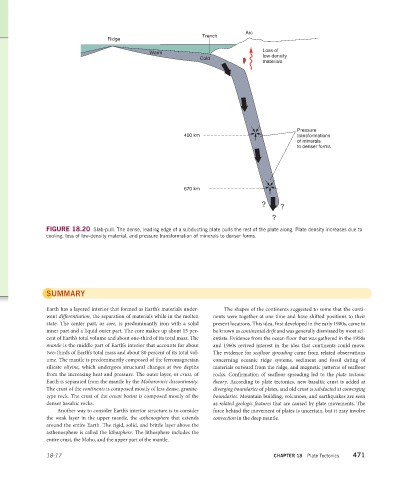
                       FIGURE 18.20  Slab-pull. The dense, leading edge of a subducting plate pulls the rest of the plate along. Plate density increases due to
                       cooling, loss of low-density material, and pressure transformation of minerals to denser forms.


                        SUMMARY


                        Earth has a layered interior that formed as Earth’s materials under-  The shapes of the continents suggested to some that the conti-
                        went differentiation, the separation of materials while in the molten   nents were together at one time and have shifted positions to their
                        state. The center part, or  core, is predominantly iron with a solid   present locations. This idea, first developed in the early 1900s, came to
                        inner part and a liquid outer part. The core makes up about 15 per-  be known as continental drift and was generally dismissed by most sci-
                        cent of Earth’s total volume and about one-third of its total mass. The   entists. Evidence from the ocean floor that was gathered in the 1950s
                        mantle is the middle part of Earth’s interior that accounts for about   and 1960s revived interest in the idea that continents could move.
                        two-thirds of Earth’s total mass and about 80 percent of its total vol-  The evidence for seafloor spreading came from related  observations
                        ume. The mantle is predominantly composed of the ferromagnesian     concerning oceanic ridge systems, sediment and fossil dating of
                        silicate  olivine, which undergoes structural changes at two depths     materials outward from the ridge, and magnetic patterns of seafloor
                        from the increasing heat and pressure. The outer layer, or crust, of   rocks. Confirmation of seafloor spreading led to the  plate  tectonic
                        Earth is separated from the mantle by the Mohorovicic discontinuity.   theory.  According to plate tectonics, new basaltic crust is added at
                        The crust of the continents is composed mostly of less dense, granite-  diverging boundaries of plates, and old crust is subducted at converging
                        type rock. The crust of the ocean basins is composed mostly of the   boundaries. Mountain building, volcanoes, and earthquakes are seen
                        denser basaltic rocks.                                 as  related geologic features that are caused by plate movements. The
                           Another way to consider Earth’s interior structure is to consider   force behind the movement of plates is uncertain, but it may  involve
                        the weak layer in the upper mantle, the  asthenosphere that extends     convection in the deep mantle.
                        around the entire Earth. The rigid, solid, and brittle layer above the
                        asthenosphere is called the lithosphere. The lithosphere includes the
                        entire crust, the Moho, and the upper part of the mantle.

                       18-17                                                                       CHAPTER 18  Plate Tectonics   471

