


Page 556 - 9780077418427.pdf
P. 556
/Volume/201/MHDQ233/tat78194_disk1of1/0073378194/tat78194_pagefile
          tiL12214_ch21_521-540.indd Page 533  9/23/10  11:10 AM user-f465
          tiL12214_ch21_521-540.indd Page 533  9/23/10  11:10 AM user-f465             /Volume/201/MHDQ233/tat78194_disk1of1/0073378194/tat78194_pagefiles


                                                                               SOLUTION
                                                            Cenozoic era       Faunal assemblage problems are solved by comparing the age ranges
                                                                               of each of the life-forms and determining the geologic time in which
                                                            Mesozoic era       the age ranges overlap. This can be visualized by creating a table that
                                                                               lists the geologic periods encompassing the age ranges of all of the
                                                            Paleozoic era
                                                                               life-forms present in the assemblage and shading the age range of each
                                                            Precambrian        life-form. In this case, the three life-forms could have only co-existed
                                                                               during the Late Ordovician through Early Silurian.

                                                                                   Geologic  Trilobite Brachiopod  Mollusk
                                                                                   Period
                                                                                Pennsylvanian
                                                     Cambrian                   Mississippian
                                                     Ordovician                 Devonian
                                                                                                                       Late
                                                     Silurian                   Silurian                               Ordovician
                                                     Devonian                   Ordovician                             through Early
                                                     Mississippian              Cambrian                               Silurian
                                                     Pennsylvanian
                                                     Permian
                                                                               EXAMPLE 21.4
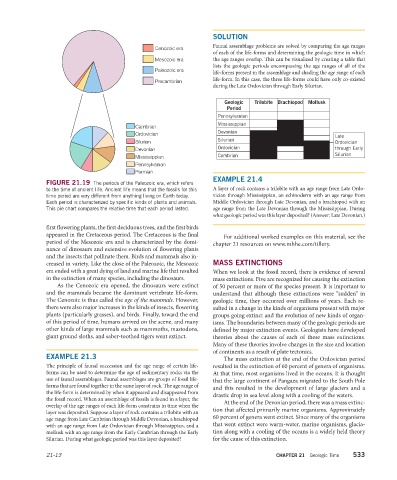
                       FIGURE 21.19  The periods of the Paleozoic era, which refers
                       to the time of ancient life. Ancient life means that the fossils for this   A layer of rock contains a trilobite with an age range from Late Ordo-
                       time period are very different from anything living on Earth today.   vician through Mississippian, an echinoderm with an age range from
                       Each period is characterized by specific kinds of plants and animals.   Middle Ordovician through Late Devonian, and a brachiopod with an
                       This pie chart compares the relative time that each period lasted.  age range from the Late Devonian through the Mississippian. During
                                                                               what geologic period was this layer deposited?  (Answer: Late Devonian.)
                       first flowering plants, the first deciduous trees, and the first birds
                       appeared in the Cretaceous period. The Cretaceous is the final   For additional worked examples on this material, see the
                       period of the Mesozoic era and is characterized by the domi-  chapter 21 resources on www.mhhe.com/tillery.
                       nance of dinosaurs and extensive evolution of flowering plants
                       and the insects that pollinate them. Birds and mammals also in-
                       creased in variety. Like the close of the Paleozoic, the Mesozoic   MASS EXTINCTIONS
                       era ended with a great dying of land and marine life that resulted   When we look at the fossil record, there is evidence of several
                       in the extinction of many species, including the dinosaurs.  mass extinctions. Five are recognized for causing the extinction
                           As the Cenozoic era opened, the dinosaurs were extinct   of 50 percent or more of the species present. It is important to
                       and the mammals became the dominant vertebrate life-form.   understand that although these extinctions were “sudden” in
                       The Cenozoic is thus called the age of the mammals. However,   geologic time, they occurred over millions of years. Each re-
                       there were also major increases in the kinds of insects, flowering   sulted in a change in the kinds of organisms present with major
                       plants (particularly grasses), and birds. Finally,  toward the end   groups going extinct and the evolution of new kinds of organ-
                       of this period of time, humans arrived on the scene, and many   isms. The boundaries between many of the geologic periods are
                       other kinds of large mammals such as mammoths, mastodons,   defined by major extinction events. Geologists have developed
                       giant ground sloths, and saber-toothed  tigers went extinct.  theories about the causes of each of these mass extinctions.
                                                                               Many of these theories involve changes in the size and location
                                                                               of continents as a result of plate tectonics.
                           EXAMPLE 21.3                                           The mass extinction at the end of the Ordovician period
                       The principle of faunal succession and the age range of certain life-    resulted in the extinction of 60 percent of genera of organisms.
                       forms can be used to determine the age of sedimentary rocks via the   At that time, most organisms lived in the oceans. It is thought
                       use of faunal assemblages. Faunal assemblages are groups of fossil life-  that the large continent of Pangaea migrated to the South Pole
                       forms that are found together in the same layer of rock. The age range of
                                                                               and this resulted in the development of large glaciers and a
                       the life-form is determined by when it appeared and disappeared from
                                                                                 drastic drop in sea level along with a cooling of the waters.
                       the fossil record. When an assemblage of fossils is found in a layer, the
                                                                                  At the end of the Devonian period, there was a mass extinc-
                       overlap of the age ranges of each life-form constrains in time when the
                                                                               tion that affected primarily marine organisms. Approximately
                       layer was deposited. Suppose a layer of rock contains a trilobite with an
                                                                               60 percent of genera went extinct. Since many of the organisms
                       age range from Late Cambrian through Middle Devonian, a brachiopod
                       with an age range from Late Ordovician through Mississippian, and a   that went extinct were warm-water, marine organisms, glacia-
                       mollusk with an age range from the Early Cambrian through the Early   tion along with a cooling of the oceans is a widely held theory
                       Silurian. During what geologic period was this layer deposited?  for the cause of this extinction.
                       21-13                                                                        CHAPTER 21  Geologic Time   533

