


Page 552 - 9780077418427.pdf
P. 552
/Volume/201/MHDQ233/tat78194_disk1of1/0073378194/tat78194_pagefile
          tiL12214_ch21_521-540.indd Page 529  9/23/10  11:10 AM user-f465
          tiL12214_ch21_521-540.indd Page 529  9/23/10  11:10 AM user-f465             /Volume/201/MHDQ233/tat78194_disk1of1/0073378194/tat78194_pagefiles


                                                                      This limestone
                                                                      and this shale
                                                                      can be correlated
                                                                      by the fossil they
                                                                      contain;
                                                                      so can
                                                                      this shale
                                                                      and this sandstone.


                                                OUTCROP
                                                    1

                                                            (The two outcrops may be
                                                            separated by long distances         OUTCROP
                                                            with no exposed rocks                   2
                                                            in between.)


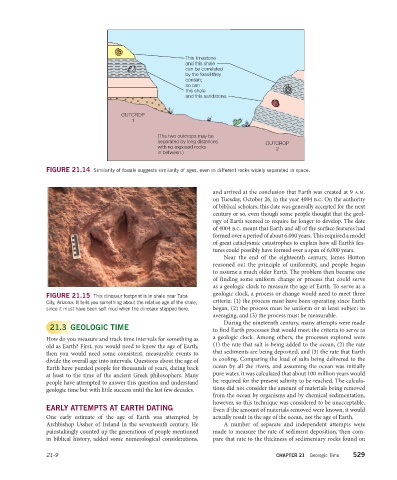
                       FIGURE 21.14  Similarity of fossils suggests similarity of ages, even in different rocks widely separated in space.


                                                                               and arrived at the conclusion that Earth was created at 9 a.m.
                                                                               on  Tuesday, October 26, in the year 4004 b.c. On the authority
                                                                               of biblical scholars, this date was generally accepted for the next
                                                                               century or so, even though some people thought that the geol-
                                                                               ogy of Earth seemed to require far longer to develop. The date
                                                                               of 4004 b.c. meant that Earth and all of the surface  features had
                                                                               formed over a period of about 6,000 years. This  required a model
                                                                               of great cataclysmic catastrophes to explain how all Earth’s fea-
                                                                               tures could possibly have formed over a span of 6,000 years.
                                                                                  Near the end of the eighteenth century, James Hutton
                                                                               reasoned out the principle of uniformity, and people began
                                                                               to  assume a much older Earth. The problem then became one
                                                                               of finding some uniform change or process that could serve
                                                                               as a geologic clock to measure the age of Earth. To serve as a
                                                                                 geologic clock, a process or change would need to meet three
                       FIGURE 21.15  This dinosaur footprint is in shale near Tuba
                       City, Arizona. It tells you something about the relative age of the shale,   criteria: (1) the process must have been operating since Earth
                       since it must have been soft mud when the dinosaur stepped here.  began, (2) the process must be uniform or at least subject to
                                                                               averaging, and (3) the process must be measurable.
                                                                                  During the nineteenth century, many attempts were made
                         21.3 GEOLOGIC TIME                                    to find Earth processes that would meet the criteria to serve as
                       How do you measure and track time intervals for something as   a geologic clock. Among others, the processes explored were
                       old as Earth? First, you would need to know the age of Earth;   (1) the rate that salt is being added to the ocean, (2) the rate
                       then you would need some consistent, measurable events to   that sediments are being deposited, and (3) the rate that Earth
                         divide the overall age into intervals. Questions about the age of   is cooling. Comparing the load of salts being delivered to the
                       Earth have puzzled people for thousands of years, dating back   ocean by all the rivers, and assuming the ocean was initially
                       at least to the time of the ancient Greek philosophers. Many   pure water, it was calculated that about 100 million years would
                       people have attempted to answer this question and understand   be required for the present salinity to be reached. The calcula-
                         geo logic time but with little success until the last few decades.  tions did not consider the amount of materials being removed
                                                                               from the ocean by organisms and by chemical sedimentation,
                                                                               however, so this technique was considered to be unacceptable.
                       EARLY ATTEMPTS AT EARTH DATING                          Even if the amount of materials removed were known, it would
                       One early estimate of the age of Earth was attempted by   actually result in the age of the ocean, not the age of Earth.
                         Archbishop Ussher of Ireland in the seventeenth century. He   A number of separate and independent attempts were
                       painstakingly counted up the generations of people mentioned   made to measure the rate of sediment deposition, then com-
                       in biblical history, added some numerological considerations,   pare that rate to the thickness of sedimentary rocks found on

                       21-9                                                                         CHAPTER 21  Geologic Time   529

