


Page 554 - 9780077418427.pdf
P. 554
/Volume/201/MHDQ233/tat78194_disk1of1/0073378194/tat78194_pagefile
          tiL12214_ch21_521-540.indd Page 531  9/23/10  11:10 AM user-f465
          tiL12214_ch21_521-540.indd Page 531  9/23/10  11:10 AM user-f465             /Volume/201/MHDQ233/tat78194_disk1of1/0073378194/tat78194_pagefiles


                                                                               explained by organic evolution and  extinction, events that could
                                                                               be used to mark the time boundaries of Earth’s geologic  history.
                                                                                  The major blocks of time in Earth’s geologic history are
                                                                               called eons, and there have been four eons since the origin of
                                                                               Earth. The Phanerozoic (Greek for “visible life”) eon is the geo-
                                                                               logic time of the abundant fossil record and living organisms.
                                                                               The eon before this time of visible life is called the Proterozoic,
                                                                               which is Greek for “beginning life.” The other two eons are the
                                                                               Prearchean and the Archean (Figure 21.17).
                                                                                  The Prearchean, Archean, and Proterozoic eons together
                                                                               are known as the Precambrian, which refers to the time  before
                                                                               the time of life. The Precambrian denotes the largest block of
                                                                               time in Earth’s history—more than 85 percent of the total time.
                                                                                  The Phanerozoic eon—the time of visible life—is divided
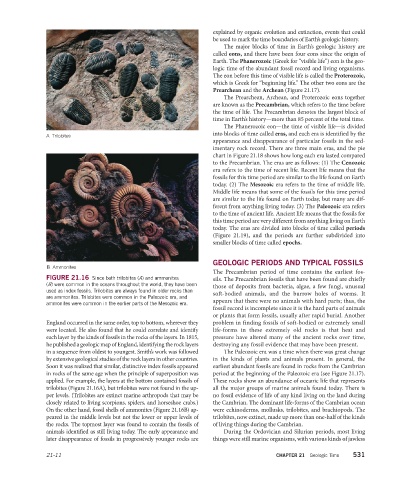
                        A  Trilobites                                          into blocks of time called eras, and each era is identified by the
                                                                               appearance and disappearance of particular fossils in the sed-
                                                                               imentary rock record. There are three main eras, and the pie
                                                                               chart in Figure 21.18 shows how long each era lasted compared
                                                                               to the Precambrian. The eras are as follows: (1) The Cenozoic
                                                                               era refers to the time of recent life. Recent life means that the
                                                                               fossils for this time period are similar to the life found on Earth
                                                                               today. (2) The Mesozoic era refers to the time of middle life.
                                                                               Middle life means that some of the fossils for this time period
                                                                               are similar to the life found on Earth today, but many are dif-
                                                                               ferent from anything living today. (3) The Paleozoic era refers
                                                                               to the time of  ancient life. Ancient life means that the fossils for
                                                                               this time period are very different from anything living on Earth
                                                                               today. The eras are divided into blocks of time called  periods
                                                                                 (Figure 21.19), and the periods are further sub divided into
                                                                               smaller blocks of time called epochs.


                                                                               GEOLOGIC PERIODS AND TYPICAL FOSSILS
                        B  Ammonites
                                                                               The Precambrian period of time contains the earliest fos-
                       FIGURE 21.16  Since both trilobites (A) and ammonites   sils. The Precambrian fossils that have been found are chiefly
                        (B) were common in the oceans throughout the world, they have been   those of  deposits from bacteria, algae, a few fungi, unusual
                        used as index fossils. Trilobites are always found in older rocks than
                                                                               soft- bodied animals, and the burrow holes of worms. It
                        are ammonites. Trilobites were common in the Paleozoic era, and
                          ammonites were common in the earlier parts of the Mesozoic era.    appears that there were no animals with hard parts; thus, the
                                                                               fossil  record is  incomplete since it is the hard parts of animals
                                                                               or plants that form fossils, usually after rapid burial.  Another
                       England occurred in the same order, top to bottom,  wherever they   problem in finding fossils of soft-bodied or extremely small
                       were located. He also found that he could correlate and identify   life-forms in these extremely old rocks is that heat and
                       each layer by the kinds of fossils in the rocks of the layers. In 1815,   pressure have altered many of the ancient rocks over time,
                       he published a geologic map of England, identifying the rock layers     destroying any fossil evidence that may have been present.
                       in a sequence from oldest to youngest. Smith’s work was followed   The Paleozoic era was a time when there was great change
                       by extensive geological studies of the rock layers in other countries.   in the kinds of plants and animals present. In general, the
                       Soon it was realized that  similar, distinctive index fossils appeared     earliest abundant fossils are found in rocks from the Cambrian
                       in rocks of the same age when the principle of superposition was     period at the beginning of the Paleozoic era (see Figure 21.17).
                       applied. For example, the layers at the bottom contained fossils of   These rocks show an abundance of oceanic life that represents
                       trilobites (Figure 21.16A), but trilobites were not found in the up-  all the major groups of marine animals found today. There is
                       per  levels. (Trilobites are extinct marine arthropods that may be   no fossil evidence of life of any kind living on the land during
                       closely related to living scorpions, spiders, and horseshoe crabs.)   the Cambrian. The dominant life-forms of the Cambrian ocean
                       On the other hand, fossil shells of ammonites (Figure 21.16B) ap-  were echinoderms, mollusks, trilobites, and brachiopods. The
                       peared in the  middle levels but not the lower or  upper levels of   trilobites, now extinct, made up more than one-half of the kinds
                       the rocks. The topmost layer was found to contain the fossils of   of living things during the Cambrian.
                       animals identified as still living today. The early appearance and   During the Ordovician and Silurian periods, most living
                       later disappearance of fossils in progressively younger rocks are   things were still marine organisms, with various kinds of jawless

                       21-11                                                                        CHAPTER 21  Geologic Time   531

