


Page 571 - 9780077418427.pdf
P. 571
/Volume/201/MHDQ233/tat78194_disk1of1/0073378194/tat78194_pagefiles
tiL12214_ch22_541-564.indd Page 548 9/23/10 11:08 AM user-f465
tiL12214_ch22_541-564.indd Page 548 9/23/10 11:08 AM user-f465 /Volume/201/MHDQ233/tat78194_disk1of1/0073378194/tat78194_pagefile
100 of air is called wind, and the direction of a wind is defined as the
Thermosphere direction from which it blows.
90
EXAMPLE 22.3
80 Mesopause
The heating of Earth’s surface is a function of the specific heat of the
surface (see Concepts Applied) and the albedo. Albedo (α) is a dimen-
70 sionless expression of the ratio of total reflected to total incident solar
radiation, called insolation ( I). If the insolation of the Sun shining on soil
Mesosphere 2 2 4 2
60 is 9.8 × 10 W/m , what is the change in temperature of a 1.0 × 10 cm
Altitude (km) 50 Stratopause the specific heat of soil is 0.2 cal/gC° and the density of soil is 1.35 g/cm .)
by 12 cm thick layer of soil in 1 hr? (Assume the albedo of the soil is 0.25,
3
40 SOLUTION
The solution of this problem requires subdividing it into smaller steps
30 Stratosphere that consider the amount of incoming solar radiation reflected into the
atmosphere, the energy transferred to the soil from the incoming solar
20 radiation, and the warming of the soil that would occur as a result of
this energy.
10 Tropopause Step 1 Determine reflected radiation. The albedo is used to deter-
Troposphere mine the amount of solar radiation reflected back into the
atmosphere. The reflected solar radiation is the product of
–80 –60 –40 –20 0 20 the albedo and the insolation.
Temperature (°C) 2 W _
insolation = 9.8 × 1 0
m 2
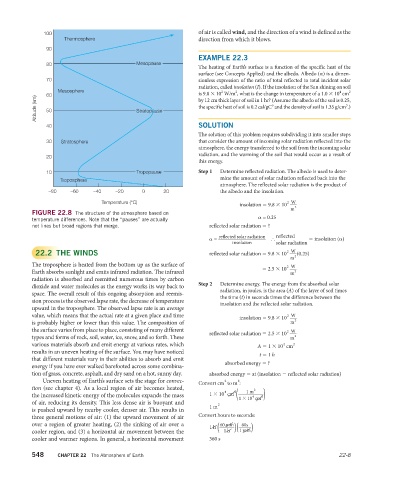
FIGURE 22.8 The structure of the atmosphere based on
temperature differences. Note that the “pauses” are actually α = 0.25
not lines but broad regions that merge. reflected solar radiation = ?
__ reflected
reflected solar radiation
α = ∴ = insolation (α)
insolation solar radiation
2 W _
22.2 THE WINDS reflected solar radiation = 9.8 × 1 0 (0.25)
m 2
The troposphere is heated from the bottom up as the surface of 2 W _
= 2.5 × 1 0
Earth absorbs sunlight and emits infrared radiation. The infrared m 2
radiation is absorbed and reemitted numerous times by carbon
Step 2 Determine energy. The energy from the absorbed solar
dioxide and water molecules as the energy works its way back to
radiation, in joules, is the area (A) of the layer of soil times
space. The overall result of this ongoing absorption and reemis-
the time (t) in seconds times the difference between the
sion process is the observed lapse rate, the decrease of temperature
insolation and the reflected solar radiation.
upward in the troposphere. The observed lapse rate is an average
2 W _
value, which means that the actual rate at a given place and time insolation = 9.8 × 1 0
is probably higher or lower than this value. The composition of m 2
the surface varies from place to place, consisting of many different reflected solar radiation = 2.5 × 1 0
2 W _
types and forms of rock, soil, water, ice, snow, and so forth. These m 2
various materials absorb and emit energy at various rates, which A = 1 × 1 0 c m
2
4
results in an uneven heating of the surface. You may have noticed
t = 1 h
that different materials vary in their abilities to absorb and emit
absorbed energy = ?
energy if you have ever walked barefooted across some combina-
tion of grass, concrete, asphalt, and dry sand on a hot, sunny day. absorbed energy = at (insolation − reflected solar radiation)
Uneven heating of Earth’s surface sets the stage for convec- 2 2
Convert c m to m :
tion (see chapter 4). As a local region of air becomes heated, 4 2 _
2
(
1 m
the increased kinetic energy of the molecules expands the mass 1 × 1 0 c m 1 × 1 0 c m 2)
4
of air, reducing its density. This less dense air is buoyant and 2
1 m
is pushed upward by nearby cooler, denser air. This results in
three general motions of air: (1) the upward movement of air Convert hours to seconds:
over a region of greater heating, (2) the sinking of air over a _ 60s
60 min _
(
)(
1 h )
cooler region, and (3) a horizontal air movement between the 1 h 1 min
cooler and warmer regions. In general, a horizontal movement 360 s
548 CHAPTER 22 The Atmosphere of Earth 22-8

