


Page 646 - 9780077418427.pdf
P. 646
Volume/207/MHDQ243/tiL12214_disk1of1/0073512214/tiL12214_pagefile
tiL12214_appa_623-630.indd Page 623 09/10/10 8:36 AM user-f463
tiL12214_appa_623-630.indd Page 623 09/10/10 8:36 AM user-f463 Volume/207/MHDQ243/tiL12214_disk1of1/0073512214/tiL12214_pagefiles
APPENDIX A
Mathematical Review
A.1 WORKING WITH EQUATIONS When one fraction is divided by another fraction, the
operation commonly applied is to “invert the denominator and
Many of the problems of science involve an equation, a short-
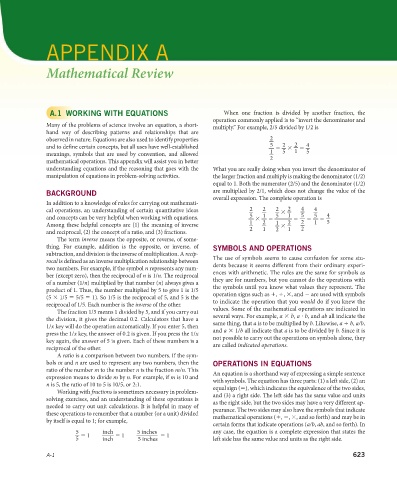
multiply.” For example, 2/5 divided by 1/2 is
hand way of describing patterns and relationships that are
2 _
observed in nature. Equations are also used to identify properties
2 _ _
5 _ _
2
4
and to define certain concepts, but all uses have well- established = × =
1 _
meanings, symbols that are used by convention, and allowed 5 1 5
mathematical operations. This appendix will assist you in better 2
understanding equations and the reasoning that goes with the What you are really doing when you invert the denominator of
manipulation of equations in problem-solving activities. the larger fraction and multiply is making the denominator (1/2)
equal to 1. Both the numerator (2/5) and the denominator (1/2)
BACKGROUND are multiplied by 2/1, which does not change the value of the
overall expression. The complete operation is
In addition to a knowledge of rules for carrying out mathemati-
2 _
4 _
4 _
2 _
2 _
2 _
cal operations, an understanding of certain quantitative ideas ×
4 _
5 _ _ _
5 _ _
1
5
and concepts can be very helpful when working with equations. × = 5 1 = = =
2 _
2 _
2 _
1 _
1 _
Among these helpful concepts are (1) the meaning of inverse × 1 5
and reciprocal, (2) the concept of a ratio, and (3) fractions. 2 1 2 1 2
The term inverse means the opposite, or reverse, of some-
thing. For example, addition is the opposite, or inverse, of SYMBOLS AND OPERATIONS
subtraction, and division is the inverse of multiplication. A recip-
The use of symbols seems to cause confusion for some stu-
rocal is defined as an inverse multiplication relationship between
dents because it seems different from their ordinary experi-
two numbers. For example, if the symbol n represents any num-
ences with arithmetic. The rules are the same for symbols as
ber (except zero), then the reciprocal of n is 1/n. The reciprocal
they are for numbers, but you cannot do the operations with
of a number (1/n) multiplied by that number (n) always gives a
the symbols until you know what values they represent. The
product of 1. Thus, the number multiplied by 5 to give 1 is 1/5
operation signs such as +, ÷, ×, and − are used with symbols
(5 × 1/5 = 5/5 = 1). So 1/5 is the reciprocal of 5, and 5 is the
to indicate the operation that you would do if you knew the
reciprocal of 1/5. Each number is the inverse of the other.
values. Some of the mathematical operations are indicated in
The fraction 1/5 means 1 divided by 5, and if you carry out
several ways. For example, a × b, a ⋅ b, and ab all indicate the
the division, it gives the decimal 0.2. Calculators that have a
same thing, that a is to be multiplied by b. Likewise, a ÷ b, a/b,
1/x key will do the operation automatically. If you enter 5, then
and a × 1/b all indicate that a is to be divided by b. Since it is
press the 1/x key, the answer of 0.2 is given. If you press the 1/x
not possible to carry out the operations on symbols alone, they
key again, the answer of 5 is given. Each of these numbers is a
are called indicated operations.
reciprocal of the other.
A ratio is a comparison between two numbers. If the sym-
bols m and n are used to represent any two numbers, then the OPERATIONS IN EQUATIONS
ratio of the number m to the number n is the fraction m/n. This
An equation is a shorthand way of expressing a simple sentence
expression means to divide m by n. For example, if m is 10 and
with symbols. The equation has three parts: (1) a left side, (2) an
n is 5, the ratio of 10 to 5 is 10/5, or 2:1.
equal sign (=), which indicates the equivalence of the two sides,
Working with fractions is sometimes necessary in problem-
and (3) a right side. The left side has the same value and units
solving exercises, and an understanding of these operations is
as the right side, but the two sides may have a very different ap-
needed to carry out unit calculations. It is helpful in many of
pearance. The two sides may also have the symbols that indicate
these operations to remember that a number (or a unit) divided
mathematical operations (+, −, ×, and so forth) and may be in
by itself is equal to 1; for example,
certain forms that indicate operations (a/b, ab, and so forth). In
5 _ _ _ any case, the equation is a complete expression that states the
5 inches
inch
= 1 = 1 = 1
5 inch 5 inches left side has the same value and units as the right side.
A-1 623

