


Page 648 - 9780077418427.pdf
P. 648
Volume/207/MHDQ243/tiL12214_disk1of1/0073512214/tiL12214_pagefile
          tiL12214_appa_623-630.indd Page 625  09/10/10  8:36 AM user-f463
          tiL12214_appa_623-630.indd Page 625  09/10/10  8:36 AM user-f463              Volume/207/MHDQ243/tiL12214_disk1of1/0073512214/tiL12214_pagefiles


                       The equation has been solved for v, and you are now ready to  substitute   can be no more accurate than the values being treated. Because the
                       quantities and perform the needed operations (see  the example   measurement had only three significant figures (two certain, one
                       problem in chapter 1 on page 13  for information on this topic).  uncertain), the  answer can have only three significant figures. The
                                                                                                           2
                                                                               area is correctly  expressed as 11.9 cm .
                                                                                  There are a few simple rules that will help you determine how
                         A.3 SIGNIFICANT FIGURES                               many significant figures are contained in a reported measurement:
                                                                                 1.  All digits reported as a direct result of a measurement are
                       The numerical value of any measurement will always contain
                       some uncertainty. Suppose, for example, that you are measur-   significant.
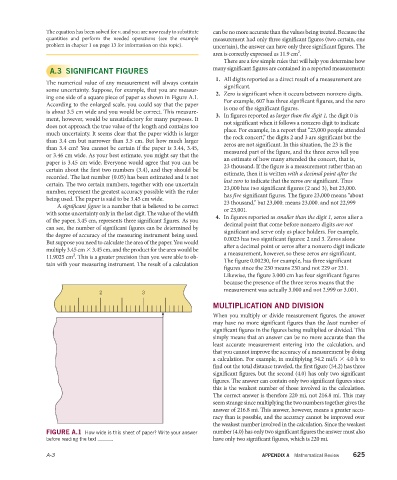
                       ing one side of a square piece of paper as shown in Figure A.1.    2.  Zero is significant when it occurs between nonzero digits.
                       According to the enlarged scale, you could say that the paper   For  example, 607 has three significant figures, and the zero
                       is about 3.5 cm  wide and you would be correct. This measure-  is one of the significant figures.
                       ment, however, would be unsatisfactory for many purposes. It    3.  In figures reported as larger than the digit 1, the digit 0 is
                       does not approach the true value of the length and contains too   not significant when it follows a nonzero digit to indicate
                       much uncertainty. It seems clear that the paper width is larger   place. For example, in a report that “23,000 people attended
                       than 3.4 cm but narrower than 3.5 cm. But how much larger   the rock  concert,” the digits 2 and 3 are significant but the
                       than 3.4 cm? You cannot be certain if the paper is 3.44, 3.45,   zeros are not significant. In this situation, the 23 is the
                       or 3.46 cm wide. As your best estimate, you might say that the   measured part of the figure, and the three zeros tell you
                       paper is 3.45 cm wide. Everyone would agree that you can be   an estimate of how many attended the  concert, that is,
                       certain about the first two numbers (3.4), and they should be   23 thousand. If the figure is a measurement rather than an
                       recorded. The last number (0.05) has been estimated and is not   estimate, then it is written with a decimal point  after the
                       certain. The two certain numbers, together with one uncertain   last zero to indicate that the zeros are significant. Thus
                       number, represent the greatest accuracy possible with the ruler   23,000 has two significant figures (2 and 3), but 23,000.
                       being used. The paper is said to be 3.45 cm wide.          has five significant figures. The figure 23,000 means “about
                           A signifi cant fi gure is a number that is believed to be correct   23 thousand,” but 23,000. means 23,000. and not 22,999
                       with some uncertainty only in the last digit. The value of the width   or 23,001.
                       of the paper, 3.45 cm, represents three significant figures. As you    4.  In figures reported as smaller than the digit 1, zeros after a
                       can see, the number of significant figures can be determined by     decimal point that come before nonzero digits are not
                       the degree of accuracy of the measuring instrument being used.   significant and serve only as place holders. For example,
                       But suppose you need to calculate the area of the paper. You would   0.0023 has two  significant figures: 2 and 3. Zeros alone
                       multiply 3.45 cm × 3.45 cm, and the product for the area would be   after a decimal point or zeros after a nonzero digit indicate
                                2
                       11.9025 cm . This is a greater precision than you were able to ob-  a measurement, however, so these zeros are significant.
                       tain with your measuring instrument. The result of a calculation   The figure 0.00230, for example, has three significant
                                                                                  figures since the 230 means 230 and not 229 or 231.
                                                                                  Likewise, the figure 3.000 cm has four  significant figures
                                                                                    because the presence of the three zeros means that the
                                                                                    measurement was actually 3.000 and not 2.999 or 3.001.
                                         2             3
                                                                               MULTIPLICATION AND DIVISION
                                                                               When you multiply or divide measurement figures, the answer
                                                                               may have no more significant figures than the least number of
                                                                               significant figures in the figures being multiplied or divided. This
                                                                               simply means that an answer can be no more accurate than the
                                                                               least accurate measurement entering into the calculation, and
                                                                               that you cannot improve the accuracy of a measurement by doing
                                                                               a calculation. For example, in multiplying 54.2 mi/h × 4.0 h to
                                                                               find out the total distance traveled, the first figure (54.2) has three
                                                                               significant figures, but the second (4.0) has only two significant
                                                                               figures. The answer can contain only two significant figures since
                                                                               this is the weakest number of those involved in the calculation.
                                                                               The correct answer is therefore 220 mi, not 216.8 mi. This may
                                                                               seem strange since multiplying the two numbers  together gives the
                                                                               answer of 216.8 mi. This  answer, however, means a greater accu-
                                                                               racy than is possible, and the accuracy  cannot be improved over
                                                                               the weakest number  involved in the calculation. Since the weakest
                       FIGURE A.1  How wide is this sheet of paper? Write your answer   number (4.0) has only two significant figures the answer must also
                       before reading the text  ——— .                          have only two significant  figures, which is 220 mi.

                       A-3                                                                     APPENDIX A  Mathematical Review   625

