Page 688 - 9780077418427.pdf
P. 688

Volume/207/MHDQ243/tiL12214_disk1of1/0073512214/tiL12214_pagefile
          tiL12214_appe_643-698.indd Page 665  09/10/10  8:37 AM user-f463
          tiL12214_appe_643-698.indd Page 665  09/10/10  8:37 AM user-f463              Volume/207/MHDQ243/tiL12214_disk1of1/0073512214/tiL12214_pagefiles


                                             6
                                               2
                                        2
                                          2
                        8.10.   (a) Argon: 1s 2s 2p 3s 3p 6                     8.18.   (a)   Bromine gained an electron to acquire a 1– charge, so it
                                             2
                                           6
                                                6
                                                  2
                                         2
                                       2
                               (b) Zinc: 1s 2s 2p 3s 3p 4s 3d 10                         must be in family VIIA (the members of this family have
                                          2
                                            2
                                              6
                                                       10
                                                    2
                                                  6
                                                2
                               (c) Bromine: 1s 2s 2p 3s 3p 4s 3d 4p 5                    seven electrons and need one more to acquire the noble
                                                                                         gas structure).
                        8.11.   Atomic weight is the weighted average of the isotopes as they
                                                                                      (b)   Potassium must have lost one electron, so it is in IA.
                               occur in nature. Th us,
                                                                                      (c)  Aluminum lost three electrons, so it is in IIIA.
                                  Lithium-6: 6.01512 u × 0.0742 = 0.446 u             (d)  Sulfur gained two electrons, so it is in VIA.
                                  Lithium-7: 7.016 u × 0.9258  = 6.4054 u             (e)  Barium lost two electrons, so it is in IIA.
                               Lithium-6 contributes 0.446 u of the weighted average and   (f)  Oxygen gained two electrons, so it is in VIA.
                               lithium-7 contributes 6.4954 u. The atomic weight of  lithium is   16  23        3       35


                                                                                8.19.   (a)          O   (b)          Na   (c)               H   (d)             Cl

                                                                                                               1
                                                                                                     11
                                                                                             8
                                                                                                                           17
                               therefore
                                               0.446 u
                                             +6.4954 u                          CHAPTER 9
                                               6.941 u                              9.1.
                        8.12.   Recall that the subscript is the atomic number, which  identifi es
                               the number of protons. In a neutral atom, the number of
                               protons equals the number of electrons, so the atomic number

                               tells you the number of electrons, too. The superscript is the

                               mass number, which identifies the number of neutrons and the

                               number of protons in the nucleus. The number of neutrons is
                               therefore the mass number minus the atomic number.
                                        Protons      Neutrons      Electrons
                               (a)         6             6             6
                               (b)         1             0             1
                               (c)        18            22            18
                               (d)         1             1             1
                               (e)        79           118            79
                               (f)        92           143            92
                        8.13.                       Period       Family
                               (a) Radon (Rn)         6           VIIIA
                               (b) Sodium (Na)        3             IA
                               (c) Copper (Cu)        4             IB
                               (d) Neon (Ne)          2           VIIIA
                               (e) Iodine (I)         5            VIIA
                               (f) Lead (Pb)          6            IVA
                        8.14.   Recall that the number of outer shell electrons is the same as
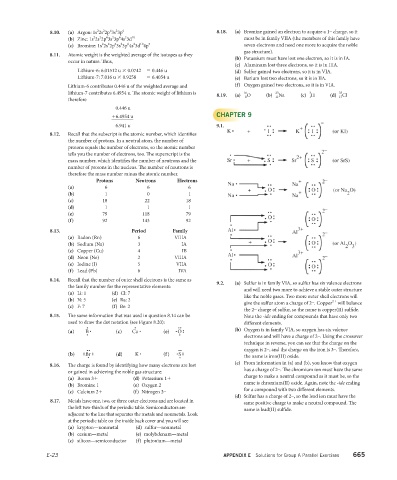
                                                                                9.2.   (a)   Sulfur is in family VIA, so sulfur has six valence  electrons
                               the family number for the representative elements:
                                                                                         and will need two more to achieve a stable outer structure
                               (a) Li: 1     (d) Cl: 7
                                                                                         like the noble gases. Two more outer shell electrons will
                               (b) N: 5      (e) Ra: 2                                                                2+
                                                                                         give the sulfur atom a charge of 2–. Copper  will balance
                               (c) F: 7      (f) Be: 2
                                                                                         the 2– charge of sulfur, so the name is copper(II) sulfi de.
                         8.15.   The same information that was used in question 8.14 can be   Note the -ide ending for compounds that have only two

                               used to draw the dot notation (see Figure 8.20):          diff erent elements.
                               (a)   B         (c)  Ca        (e)  O                  (b)   Oxygen is in family VIA, so oxygen has six valence
                                                                                           electrons and will have a charge of 2–. Using the crossover
                                                                                         technique in reverse, you can see that the charge on the
                                                                                         oxygen is 2–, and the charge on the iron is 3–. Th erefore,
                               (b)  Br         (d)   K        (f)  S                     the name is iron(III) oxide.
                                                                                      (c)   From information in (a) and (b), you know that  oxygen
                        8.16.   The charge is found by identifying how many electrons are lost

                                                                                         has a charge of 2–. The chromium ion must have the same

                               or gained in achieving the noble gas structure:
                               (a) Boron 3+         (d) Potassium 1+                     charge to make a neutral compound as it must be, so the
                               (b) Bromine 1–       (e) Oxygen 2–                        name is chromium(II) oxide. Again, note the -ide ending
                               (c) Calcium 2+       (f) Nitrogen 3–                      for a compound with two  diff erent elements.
                                                                                      (d)   Sulfur has a charge of 2–, so the lead ion must have the
                        8.17.   Metals have one, two, or three outer electrons and are located in   same positive charge to make a neutral compound. Th e
                               the left two-thirds of the periodic table. Semiconductors are   name is lead(II) sulfi de.

                               adjacent to the line that separates the metals and nonmetals. Look
                               at the periodic table on the inside back cover and you will see
                               (a) krypton—nonmetal   (d) sulfur—nonmetal
                               (b) cesium—metal      (e) molybdenum—metal
                               (c) silicon—semiconductor   (f)  plutonium—metal
                       E-23                                                       APPENDIX E  Solutions for Group A Parallel Exercises   665
   683   684   685   686   687   688   689   690   691   692   693