


Page 689 - 9780077418427.pdf
P. 689
Volume/207/MHDQ243/tiL12214_disk1of1/0073512214/tiL12214_pagefile
tiL12214_appe_643-698.indd Page 666 09/10/10 8:37 AM user-f463
tiL12214_appe_643-698.indd Page 666 09/10/10 8:37 AM user-f463 Volume/207/MHDQ243/tiL12214_disk1of1/0073512214/tiL12214_pagefiles
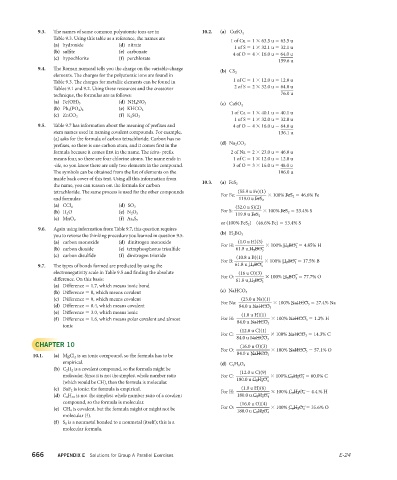
9.3. The names of some common polyatomic ions are in 10.2. (a) CuSO 4
Table 9.3. Using this table as a reference, the names are
1 of Cu = 1 × 63.5 u = 63.5 u
(a) hydroxide (d) nitrate
1 of S = 1 × 32.1 u = 32.1 u
(b) sulfi te (e) carbonate
4 of O = 4 × 16.0 u = 64.0 u
(c) hypochlorite (f) perchlorate
159.6 u
9.4. The Roman numeral tells you the charge on the variable-charge
(b) CS 2
elements. The charges for the polyatomic ions are found in
Table 9.3. The charges for metallic elements can be found in 1 of C = 1 × 12.0 u = 12.0 u
Tables 9.1 and 9.2. Using these resources and the crossover 2 of S = 2 × 32.0 u = 64.0 u
technique, the formulas are as follows: 76.0 u
(a) Fe(OH) 3 (d) NH 4 NO 3
(c) CaSO 4
(b) Pb 3 (PO 4 ) 2 (e) KHCO 3
1 of Ca = 1 × 40.1 u = 40.1 u
(c) ZnCO 3 (f) K 2 SO 3
1 of S = 1 × 32.0 u = 32.0 u
9.5. Table 9.7 has information about the meaning of prefi xes and 4 of O = 4 × 16.0 u = 64.0 u
stem names used in naming covalent compounds. For example, 136.1 u
(a) asks for the formula of carbon tetrachloride. Carbon has no
prefixes, so there is one carbon atom, and it comes first in the (d) Na 2 CO 3
formula because it comes first in the name. Th e tetra- prefi x 2 of Na = 2 × 23.0 u = 46.0 u
means four, so there are four chlorine atoms. The name ends in 1 of C = 1 × 12.0 u = 12.0 u
-ide, so you know there are only two elements in the compound. 3 of O = 3 × 16.0 u = 48.0 u
The symbols can be obtained from the list of elements on the 106.0 u
inside back cover of this text. Using all this information from
10.3. (a) FeS 2
the name, you can reason out the formula for carbon
(55.9 u Fe)(1)
tetrachloride. The same process is used for the other compounds __
×
For Fe: 100% FeS 2 = 46.6% Fe
and formulas: 119.0 u FeS 2
(a) CCl 4 (d) SO 3 __
(32.0 u S)(2)
×
(b) H 2 O (e) N 2 O 5 For S: 100% FeS 2 = 53.4% S
119.9 u FeS 2
(c) MnO 2 (f) As 2 S 5
or (100% FeS 2 ) – (46.6% Fe) = 53.4% S
9.6. Again using information from Table 9.7, this question requires
you to reverse the thinking procedure you learned in question 9.5. (b) H 3 BO 3
(1.0 u H)(3)
(a) carbon monoxide (d) dinitrogen monoxide __
×
For H: 100% H 3 BO 2 = 4.85% H
(b) carbon dioxide (e) tetraphosphorus trisulfi de 61.8 u H 3 BO 3
(c) carbon disulfi de (f) dinitrogen trioxide __
(10.8 u B)(1)
For B: × 100% H 3 BO 3 = 17.5% B
9.7. The types of bonds formed are predicted by using the 61.8 u H 3 BO 3
electronegativity scale in Table 9.5 and finding the absolute __
(16 u O)(3)
×
For O: 100% H 3 BO 3 = 77.7% O
difference. On this basis: 61.8 u H 3 BO 3
(a) Diff erence = 1.7, which means ionic bond
(b) Diff erence = 0, which means covalent (c) NaHCO 3
(23.0 u Na)(1)
(c) Diff erence = 0, which means covalent __
For Na: × 100% NaHCO 3 = 27.4% Na
(d) Diff erence = 0.4, which means covalent 84.0 u NaHCO 3
(e) Diff erence = 3.0, which means ionic __
(1.0 u H)(1)
(f) Diff erence = 1.6, which means polar covalent and almost For H: × 100% NaHCO 3 = 1.2% H
84.0 u NaHCO 3
ionic
__
(12.0 u C)(1)
For C: × 100% NaHCO 3 = 14.3% C
84.0 u NaHCO 3
CHAPTER 10 __
(16.0 u O)(3)
For O: × 100% NaHCO 3 = 57.1% O
10.1. (a) MgCl 2 is an ionic compound, so the formula has to be 84.0 u NaHCO 3
empirical.
(d) C 9 H 8 O 4
(b) C 2 H 2 is a covalent compound, so the formula might be
(12.0 u C)(9)
molecular. Since it is not the simplest whole number ratio For C: __
× 100% C 9 H 8 O 4 = 60.0% C
(which would be CH), then the formula is molecular. 180.0 u C 9 H 8 O 4
(1.0 u H)(8)
(c) BaF 2 is ionic; the formula is empirical. __
For H: × 100% C 9 H 8 O 4 = 4.4.% H
(d) C 8 H 18 is not the simplest whole number ratio of a covalent 180.0 u C 9 H 8 O 4
compound, so the formula is molecular. __
(16.0 u O)(4)
(e) CH 4 is covalent, but the formula might or might not be For O: × 100% C 9 H 8 O 4 = 35.6% O
180.0 u C 9 H 8 O 4
molecular (?).
(f) S 8 is a nonmetal bonded to a nonmetal (itself); this is a
molecular formula.
666 APPENDIX E Solutions for Group A Parallel Exercises E-24

