


Page 691 - 9780077418427.pdf
P. 691
Volume/207/MHDQ243/tiL12214_disk1of1/0073512214/tiL12214_pagefile
tiL12214_appe_643-698.indd Page 668 09/10/10 8:37 AM user-f463
tiL12214_appe_643-698.indd Page 668 09/10/10 8:37 AM user-f463 Volume/207/MHDQ243/tiL12214_disk1of1/0073512214/tiL12214_pagefiles
ppm
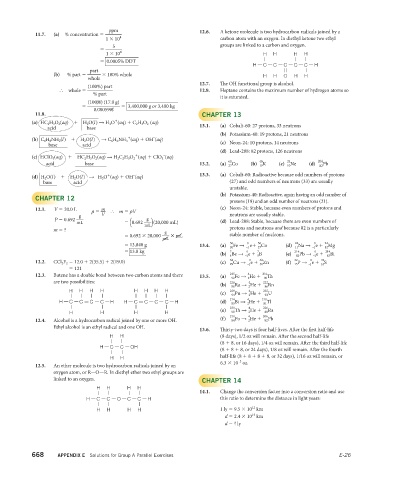
_ 12.6. A ketone molecule is two hydrocarbon radicals joined by a
11.7. (a) % concentration =
1 × 10 4 carbon atom with an oxygen. In diethyl ketone two ethyl
_ groups are linked to a carbon and oxygen.
5
=
1 × 10 4 H H H H
= 0.0005% DDT
H C C C C C H
part
_
(b) % part = × 100% whole H H O H H
whole
12.7. The OH functional group is alcohol.
(100%) part
_
∴ whole = 12.8. Heptane contains the maximum number of hydrogen atoms so
% part
it is saturated.
(100%) (17.0 g)
__
=
= 3,400,000 g or 3,400 kg
0.00059%
11.8. CHAPTER 13
+ –
(a) HC 2 H 3 O 2 (aq) + H 2 O(l ) → H 3 O (aq) + C 2 H 3 O 2 (aq)
acid base 13.1. (a) Cobalt-60: 27 protons, 33 neutrons
(b) Potassium-40: 19 protons, 21 neutrons
+ –
(b) C 6 H 6 NH 2 (l ) + H 2 O(l ) → C 6 H 6 NH 3 (aq) + OH (aq)
base acid (c) Neon-24: 10 protons, 14 neutrons
(d) Lead-208: 82 protons, 126 neutrons
+ –
(c) HClO 4 (aq) + HC 2 H 3 O 2 (aq) → H 2 C 2 H 3 O 2 (aq) + ClO 4 (aq)
60 40 24 204
acid base 13.2. (a) Co (b) K (c) Ne (d) Pb
10
82
19
27
+ – 13.3. (a) Cobalt-60: Radioactive because odd numbers of protons
(d) H 2 O(l ) + H 2 O(l ) → H 3 O (aq) + OH (aq)
base acid (27) and odd numbers of neutrons (33) are usually
unstable.
(b) Potassium-40: Radioactive, again having an odd number of
CHAPTER 12
protons (19) and an odd number of neutrons (21).
12.1. V = 20.0 L m _ (c) Neon-24: Stable, because even numbers of protons and
ρ = ∴ m = ρV neutrons are usually stable.
V
g
_
Ρ = 0.692 _
g
mL = ( 0.692 ) (20,000 mL) (d) Lead-208: Stable, because there are even numbers of
mL
m = ? g protons and neutrons and because 82 is a particularly
_
= 0.692 × 20,000 × mL stable number of nucleons.
mL
24
0
24
56
56
0
= 13,840 g 13.4. (a) Fe → e+ Co (d) Na → e + Mg
11
26
12
–l
27
–l
= 13.8 kg 7 0 7 214 0 214
(b) Be → e + B (e) Pb → e + Bi
4
–l
5
–l
82
83
64
0
64
0
32
32
12.2. CCl 2 F 2 = 12.0 + 2(35.5) + 2(19.0) (c) Cu → e + Zn (f) P → e + S
16
15
29
30
–l
–l
= 121
231
235
4
12.3. Butene has a double bond between two carbon atoms and there 13.5. (a) Fe → He + Th
2
92
90
are two possibilities: 226 4 222
(b) Ra → He + Rn
86
88
2
H H H H H H H H 239 4 235
(c) Pu → He + U
94
2
92
214 4 210
H C C C C H H C C C C H (d) Bi → He + Tl
83
2
81
230 4 226
(e) Th → He + Ra
H H H H 90 2 88
210 4 206
12.4. Alcohol is a hydrocarbon radical joined by one or more OH. (f) Po → He + Pb
82
84
2
Ethyl alcohol is an ethyl radical and one OH.
13.6. Thirty-two days is four half-lives. After the fi rst half-life
H H (8 days), 1/2 oz will remain. After the second half-life
(8 + 8, or 16 days), 1/4 oz will remain. After the third half-life
H C C OH
(8 + 8 + 8, or 24 days), 1/8 oz will remain. After the fourth
H H half-life (8 + 8 + 8 + 8, or 32 days), 1/16 oz will remain, or
–2
6.3 × 10 oz.
12.5. An ether molecule is two hydrocarbon radicals joined by an
oxygen atom, or R—O—R. In diethyl ether two ethyl groups are
linked to an oxygen. CHAPTER 14
H H H H
14.1. Change the conversion factor into a conversion ratio and use
H C C O C C H this ratio to determine the distance in light years:
12
H H H H 1 ly = 9.5 × 10 km
14
d = 2.4 × 10 km
d = ? ly
668 APPENDIX E Solutions for Group A Parallel Exercises E-26

