


Page 690 - 9780077418427.pdf
P. 690
Volume/207/MHDQ243/tiL12214_disk1of1/0073512214/tiL12214_pagefile
tiL12214_appe_643-698.indd Page 667 09/10/10 8:37 AM user-f463
tiL12214_appe_643-698.indd Page 667 09/10/10 8:37 AM user-f463 Volume/207/MHDQ243/tiL12214_disk1of1/0073512214/tiL12214_pagefiles
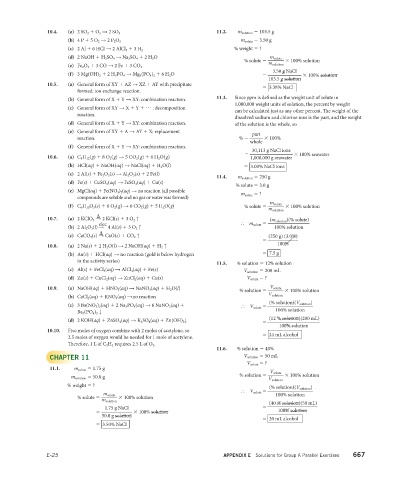
10.4. (a) 2 SO 2 + O 2 → 2 SO 3 11.2. m solution = 103.5 g
m solute = 3.50 g
(b) 4 P + 5 O 2 → 2 P 2 O 5
% weight = ?
(c) 2 Al + 6 HCl → 2 AlCl 3 + 3 H 2
(d) 2 NaOH + H 2 SO 4 → Na 2 SO 4 + 2 H 2 O _
m solute
% solute = × 100% solution
m solution
(e) Fe 2 O 3 + 3 CO → 2 Fe + 3 CO 2
3.50 g NaCl
(f) 3 Mg(OH) 2 + 2 H 3 PO 4 → Mg 3 (PO 4 ) 2 + 6 H 2 O = __ × 100% solution
103.5 g solution
10.5. (a) General form of XY + AZ → XZ + AY with precipitate
= 3.38% NaCl
formed: ion exchange reaction.
11.3. Since ppm is defined as the weight unit of solute in
(b) General form of X + Y → XY: combination reaction.
1,000,000 weight units of solution, the percent by weight
(c) General form of XY → X + Y + . . . : decomposition
can be calculated just as any other percent. The weight of the
reaction.
dissolved sodium and chlorine ions is the part, and the weight
(d) General form of X + Y → XY: combination reaction. of the solution is the whole, so
(e) General form of XY + A → AY + X: replacement part
reaction. % = _ × 100%
whole
(f) General form of X + Y → XY: combination reaction.
30,113 g NaCl ions
__
=
× 100% seawater
10.6. (a) C 5 H 12 ( g) + 8 O 2 ( g) → 5 CO 2 ( g) + 6 H 2 O( g) 1,000,000 g seawater
(b) HCl(aq) + NaOH(aq) → NaCl(aq) + H 2 O(l) = 3.00% NaCl ions
(c) 2 Al(s) + Fe 2 O 3 (s) → Al 2 O 3 (s) + 2 Fe(l)
11.4. m solution = 250 g
(d) Fe(s) + CuSO 4 (aq) → FeSO 4 (aq) + Cu(s)
% solute = 3.0 g
(e) MgCl(aq) + Fe(NO 3 ) 2 (aq) → no reaction (all possible
m solute = ?
compounds are soluble and no gas or water was formed)
_
m solute
(f) C 6 H 10 O 5 (s) + 6 O 2 ( g) → 6 CO 2 ( g) + 5 H 2 O( g) % solute = × 100% solution
m solution
Δ
10.7. (a) 2 KClO 3 → 2 KCl(s) + 3 O 2 ↑ __
(m solution )(% solute)
elec ∴ m solute =
(b) 2 Al 2 O 3 (l) → 4 Al(s) + 3 O 2 ↑ 100% solution
Δ
(c) CaCO 3 (s) → CaO(s) + CO 2 ↑ (250 g) (3.0%)
__
=
10.8. (a) 2 Na(s) + 2 H 2 O(l) → 2 NaOH(aq) + H 2 ↑ 100%
(b) Au(s) + HCl(aq) → no reaction (gold is below hydrogen = 7.5 g
in the activity series)
11.5. % solution = 12% solution
(c) Al(s) + FeCl 3 (aq) → AlCl 3 (aq) + Fe(s) V solution = 200 mL
(d) Zn(s) + CuCl 2 (aq) → ZnCl 2 (aq) + Cu(s) V solute = ?
10.9. (a) NaOH(aq) + HNO 3 (aq) → NaNO 3 (aq) + H 2 O(l) _
V solute
% solution = × 100% solution
(b) CaCl 2 (aq) + KNO 3 (aq) →no reaction V solution
(% solution)(V solution )
(c) 3 Ba(NO 3 ) 2 (aq) + 2 Na 3 PO 4 (aq) → 6 NaNO 3 (aq) + ∴ V solute = __
Ba 3 (PO 4 ) 2 ↓ 100% solution
(12 % solution)(200 mL)
(d) 2 KOH(aq) + ZnSO 4 (aq) → K 2 SO 4 (aq) + Zn(OH) 2 ↓ = ___
100% solution
10.10. Five moles of oxygen combine with 2 moles of acetylene, so
= 24 mL alcohol
2.5 moles of oxygen would be needed for 1 mole of acetylene.
Therefore, 1 L of C 2 H 2 requires 2.5 L of O 2 .
11.6. % solution = 40%
CHAPTER 11 V solution = 50 mL
V solute = ?
11.1. m solute = 1.75 g _
V solute
m solution = 50.0 g % solution = × 100% solution
V solution
% weight = ? __
(% solution)(V solution )
∴ V solute =
_ 100% solution
m solute
% solute = × 100% solution
m solution __
(40 % solution)(50 mL)
1.75 g NaCl
__ =
= × 100% solution 100% solution
50.0 g solution
= 20 mL alcohol
= 3.50% NaCl
E-25 APPENDIX E Solutions for Group A Parallel Exercises 667

