


Page 692 - 9780077418427.pdf
P. 692
Volume/207/MHDQ243/tiL12214_disk1of1/0073512214/tiL12214_pagefiles
tiL12214_appe_643-698.indd Page 669 09/10/10 8:37 AM user-f463
tiL12214_appe_643-698.indd Page 669 09/10/10 8:37 AM user-f463 Volume/207/MHDQ243/tiL12214_disk1of1/0073512214/tiL12214_pagefile
12
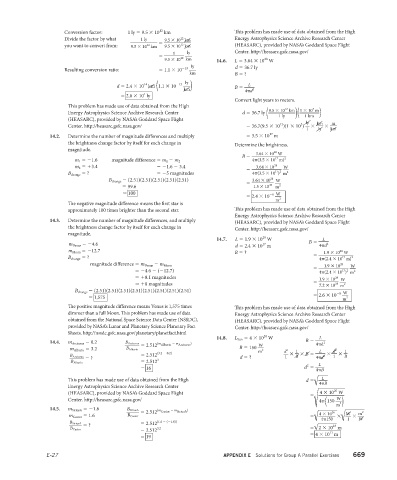
Conversion factor: 1 ly = 9.5 × 10 km This problem has made use of data obtained from the High
Divide the factor by what __ = __ Energy Astrophysics Science Archive Research Center
12
1 ly
9.5 × 10 km
12
you want to convert from: 9.5 × 10 km 9.5 × 10 km (HEASARC), provided by NASA’s Goddard Space Flight
12
ly
_ _ Center. http://heasarc.gsfc.nasa.gov/
1
=
9.5 × 10 12 km 14.6. L = 3.64 × 10 W
28
ly
−13 _ d = 36.7 ly
Resulting conversion ratio: = 1.1 × 10
km B = ?
ly
L
14
d = 2.4 × 10 km ( 1.1 × 10 −13 _ B = _
)
km 4πd 2
1
= 2.6 × 10 ly
Convert light years to meters.
This problem has made use of data obtained from the High 12 3
(
1 ly )(
9.5 × 10 km _
1 × 10 m
Energy Astrophysics Science Archive Research Center d = 36.7 ly __ 1 km )
(HEASARC), provided by NASA’s Goddard Space Flight ly
_
3 _
m _
km
12
Center. http://heasarc.gsfc.nasa.gov/ = 36.7(9.5 × 10 )(1 × 10 ) × ×
1 ly km
17
14.2. Determine the number of magnitude differences and multiply = 3.5 × 10 m
the brightness change factor by itself for each change in Determine the brightness.
magnitude.
28
__
3.64 × 10 W
B =
17
m 1 = −1.6 magnitude difference = m 1 − m 2 4π(3.5 × 10 m) 2
28
m 2 = +3.4 = −1.6 − 3.4 __ W _
3.64 × 10
=
17 2
B change = ? = −5 magnitudes 4π(3.5 × 10 ) m 2
28
B change = (2.51)(2.51)(2.51)(2.51)(2.51) 3.64 × 10 _
_ W
=
= 99.6 1.5 × 10 36 m 2
≈ 100 −8 W _
= 2.4 × 10
m 2
The negative magnitude difference means the first star is
approximately 100 times brighter than the second star. This problem has made use of data obtained from the High
Energy Astrophysics Science Archive Research Center
14.3. Determine the number of magnitude differences, and multiply (HEASARC), provided by NASA’s Goddard Space Flight
the brightness change factor by itself for each change in Center. http://heasarc.gsfc.nasa.gov/
magnitude.
28
L
14.7. L = 1.9 × 10 W _
m Venus = −4.6 d = 2.4 × 10 m B = 4πd
17
2
m Moon = −12.7 B = ? __
28
1.9 × 10 W
B change = ? = 4π(2.4 × 10 m) 2
17
28
1.9 × 10
magnitude difference = m Venus − m Moon __ W _
=
= −4.6 − (−12.7) 4π(2.4 × 10 ) m 2
17 2
= +8.1 magnitudes 1.9 × 10 _
28
_ W
=
≈ +8 magnitudes 7.2 × 10 35 m 2
B change = (2.51)(2.51)(2.51)(2.51)(2.51)(2.51)(2.51)(2.51) −8 W _
= 2.6 × 10
= 1,575 m 2
The positive magnitude difference means Venus is 1,575 times This problem has made use of data obtained from the High
dimmer than a full Moon. This problem has made use of data Energy Astrophysics Science Archive Research Center
obtained from the National Space Science Data Center (NSSDC), (HEASARC), provided by NASA’s Goddard Space Flight
provided by NASA’s Lunar and Planetary Science Planetary Fact Center. http://heasarc.gsfc.nasa.gov/
Sheets. http://nssdc.gsfc.nasa.gov/planetary/planetfact.html
26
14.8. L Sun = 4 × 10 W _
L
14.4. m Arcturus = 0.2 _ = 2.512 (m Alberio − m Arcturus ) W _ B = 4πd
2
B Arcturus
m Alberio = 3.2 B Alberio B = 150 d _ 2 1 _ _ _ 2 1 _
2
d
L
m
_ = 2.512 (3.2 − 0.2) × × B = × ×
B
2
1
1
B
B Arcturus
= ? 3 d = ? 4πd
B Alberio = 2.512 2 L _
= 16 d =
4πB
L _
√
This problem has made use of data obtained from the High d =
Energy Astrophysics Science Archive Research Center 4πB
26
__
4 × 10 W
(HEASARC), provided by NASA’s Goddard Space Flight =
W _
(
2)
Center. http://heasarc.gsfc.nasa.gov/ √ 4π 150
m
14.5. m SiriusA = −1.6 _ = 2.512 (m Castor − m SiriusA )
B SiriusA
m _
26
W _
4 × 10
m Castor = 1.6 B Castor = √ _ × 2
√ ×
W
1
4π150
_ = 2.512 (1.6 − (−1.6))
B SiriusA
= ? 23
B Castor = 2.512 3.2 = √ 2 × 10 m
11
= 4 × 10 m
= 19
E-27 APPENDIX E Solutions for Group A Parallel Exercises 669

