


Page 697 - 9780077418427.pdf
P. 697
Volume/207/MHDQ243/tiL12214_disk1of1/0073512214/tiL12214_pagefile
tiL12214_appe_643-698.indd Page 674 09/10/10 8:37 AM user-f463
tiL12214_appe_643-698.indd Page 674 09/10/10 8:37 AM user-f463 Volume/207/MHDQ243/tiL12214_disk1of1/0073512214/tiL12214_pagefiles
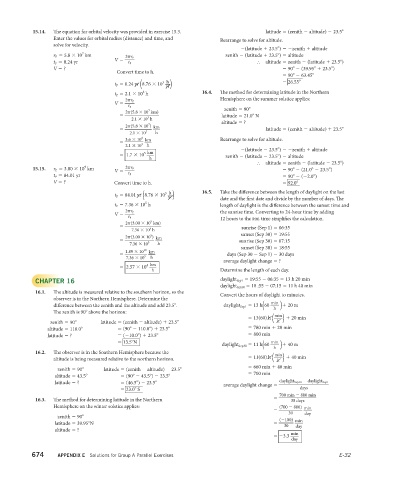
15.14. The equation for orbital velocity was provided in exercise 15.3. latitude = (zenith − altitude) − 23.5°
Enter the values for orbital radius (distance) and time, and Rearrange to solve for altitude.
solve for velocity.
−(latitude + 23.5°) = −zenith + altitude
7
r P = 5.8 × 10 km _ zenith − (latitude + 23.5°) = altitude
2πr P
V =
t P = 0.24 yr t P ∴ altitude = zenith − (latitude + 23.5°)
V = ? = 90° − (39.95° + 23.5°)
Convert time to h.
= 90° − 63.45°
yr)
3 h _ = 26.55°
t P = 0.24 yr ( 8.76 × 10
3
t P = 2.1 × 10 h 16.4. The method for determining latitude in the Northern
_ Hemisphere on the summer solstice applies:
2πr P
V =
t P zenith = 90°
7
2π(5.8 × 10 km)
__
= latitude = 21.0° N
3
2.1 × 10 h
7 altitude = ?
__ _
2π(5.8 × 10 ) km
= latitude = (zenith − altitude) + 23.5°
2.1 × 10 3 h
8
_ _ Rearrange to solve for altitude.
3.6 × 10 km
=
2.1 × 10 3 h
−(latitude − 23.5°) = −zenith + altitude
_
5 km
= 1.7 × 10
h zenith − (latitude − 23.5°) = altitude
∴ altitude = zenith − (latitude − 23.5°)
9
15.15. r P = 3.00 × 10 km _ = 90° − (21.0° − 23.5°)
2πr P
V =
t P = 84.01 yr t P = 90° − (−2.0°)
V = ? Convert time to h. = 92.0°
yr)
3 h _ 16.5. Take the difference between the length of daylight on the last
t P = 84.01 yr ( 8.76 × 10 date and the first date and divide by the number of days. Th e
5
t P = 7.36 × 10 h length of daylight is the difference between the sunset time and
_ the sunrise time. Converting to 24-hour time by adding
2πr P
V =
t P 12 hours to the p.m. time simplifies the calculation.
9
2π(3.00 × 10 km)
__
= sunrise (Sep 1) = 06:35
5
7.36 × 10 h
9 sunset (Sep 30) = 19:55
__ _
2π(3.00 × 10 ) km
= sunrise (Sep 30) = 07:15
7.36 × 10 5 h
sunset (Sep 30) = 18:55
10
1.89 × 10 _
_ km
= days (Sep 30 − Sep 1) = 30 days
7.36 × 10 5 h
average daylight change = ?
_
4 km
= 2.57 × 10
h Determine the length of each day.
CHAPTER 16 daylight Sep1 = 19:55 − 06:35 = 13 h 20 min
daylight Sep30 = 18 :55 − 07:15 = 11 h 40 min
16.1. The altitude is measured relative to the southern horizon, so the
Convert the hours of daylight to minutes.
observer is in the Northern Hemisphere. Determine the
_
(
min
)
difference between the zenith and the altitude and add 23.5°. daylight Sep1 = 13 h 60 + 20 m
h
The zenith is 90° above the horizon:
_
( )
min
= 13(60) h + 20 min
zenith = 90° latitude = (zenith − altitude) + 23.5° h
altitude = 110.0° = (90° − 110.0°) + 23.5° = 780 min + 20 min
latitude = ? = (−10.0°) + 23.5° = 800 min
(
min
)
= 13.5°N _
daylight Sep30 = 11 h 60 + 40 m
h
16.2. The observer is in the Southern Hemisphere because the _
min
( )
altitude is being measured relative to the northern horizon. = 11(60) h + 40 min
h
zenith = 90° latitude = (zenith − altitude) − 23.5° = 660 min + 40 min
altitude = 43.5° = (90° − 43.5°) − 23.5° = 700 min
latitude = ? = (46.5°) − 23.5° __
daylight Sep30 − daylight Sep1
average daylight change =
= 23.0° S days
__
700 min − 800 min
16.3. The method for determining latitude in the Northern = 30 days
Hemisphere on the winter solstice applies: _ _
(700 − 800) min
= 30
zenith = 90° day
_ _
(−100) min
latitude = 39.95°N =
30 day
altitude = ?
min
= −3.3 _
day
674 APPENDIX E Solutions for Group A Parallel Exercises E-32

