


Page 699 - 9780077418427.pdf
P. 699
Volume/207/MHDQ243/tiL12214_disk1of1/0073512214/tiL12214_pagefiles
tiL12214_appe_643-698.indd Page 676 09/10/10 8:37 AM user-f463
tiL12214_appe_643-698.indd Page 676 09/10/10 8:37 AM user-f463 Volume/207/MHDQ243/tiL12214_disk1of1/0073512214/tiL12214_pagefile
longitude = 1° _ ) _
longitude
Gm Moon m Earth
3
radius 80° = 1.108 × 10 km d = 2πradius 80° ( 360° F = d 2
1°
d = ? 3 _ −11 N⋅m 2 22 24
_
( )
= 2π1.108 × 10 km 360° ( 6.67 × 10 kg 2 )
(7.37 × 10 kg)(5.97 × 10 kg)
3
−3
= 2π1.108 × 10 (2.7778 × 10 ) km = _____
2
8
(4.064 × 10 m)
1
= 1.934 × 10 km 2
_
N⋅m
= 19.34 km −11 22 24 ( )
(kg)(kg)
2
(6.67 × 10
kg
)(7.37 × 10 )(5.97 × 10 )
____ __
=
8 2
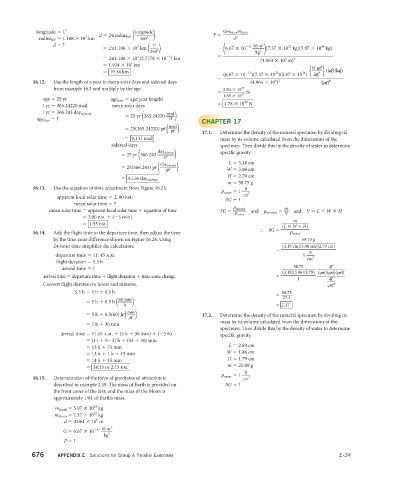
16.12. Use the length of a year in mean solar days and sidereal days (4.064 × 10 ) (m) 2
37
from example 16.3 and multiply by the age. _
2.94 × 10
N
=
1.65 × 10 17
age = 25 yr age days = age(year length) 20
1 yr = 365.24220 msd mean solar days = 1.78 × 10 N
1 yr = 366.243 day sidereal = 25 yr ( 365.24220 )
_
msd
age days = ? yr
CHAPTER 17
_
= 25(365.24220) yr ( )
msd
yr 17.1. Determine the density of the mineral specimen by dividing its
= 9,131 msd mass by its volume calculated from the dimensions of the
sidereal days specimen. Then divide this by the density of water to determine
_ ) specifi c gravity.
day sidereal
= 25 yr ( 366.243
yr
_ ) L = 3.18 cm
day sidereal
= 25(366.243) yr (
yr W = 3.06 cm
= 9,156 day sidereal H = 2.79 cm
m = 58.75 g
g
16.13. Use the equation of time adjustment from Figure 16.23. _
ρ water = 1
cm 3
apparent local solar time = 2: 00 p.m.
SG = ?
mean solar time = ?
_ m _
ρ mineral
mean solar time = apparent local solar time + equation of time SG = and ρ mineral = and V = L × W × H
ρ water V
= 2:00 p.m. + (−5 min)
m
= 1:55 p.m. __
(L × W × H)
∴ SG = __
16.14. Add the flight time to the departure time, then adjust the time ρ water
58.75 g
by the time zone difference shown on Figure 16.24. Using ___
24-hour time simplifies the calculation: ___
(3.18 cm)(3.06 cm)(2.79 cm)
=
g
_
departure time = 11: 45 a.m. 1
cm 3
flight duration = 5.5 h
g
58.75
arrival time = ? __ __
__ __
(3.18)(3.06)(2.79) (cm)(cm)(cm)
arrival time = departure time + flight duration + time zone change = g
1 _
Convert flight duration to hours and minutes. cm 3
5.5 h = 5 h + 0.5 h _
58.75
= 27.1
(
)
60 min
= 5 h + 0.5 h _
h = 2.17
( )
_
min
= 5 h + 0.5(60) h 17.2. Determine the density of the mineral specimen by dividing its
h
mass by its volume calculated from the dimensions of the
= 5 h + 30 min
specimen. Then divide this by the density of water to determine
arrival time = 11:45 a.m. + (5 h + 30 min) + (−3 h) specifi c gravity.
= (11 + 5−3) h + (45 + 30) min
= 13 h + 75 min L = 2.89 cm
= 13 h + 1 h + 15 min W = 1.86 cm
= 14 h + 15 min H = 1.79 cm
= 14:15 or 2:15 p.m. m = 25.09 g
g
_
ρ water = 1
16.15. Determination of the force of gravitational attraction is cm 3
described in example 2.18. The mass of Earth is provided on SG = ?
the front cover of the text, and the mass of the Moon is
approximately 1/81 of Earth’s mass.
24
m Earth = 5.97 × 10 kg
22
m Moon = 7.37 × 10 kg
8
d = 4.064 × 10 m
_
−11 N⋅m 2
G = 6.67 × 10
kg 2
F = ?
676 APPENDIX E Solutions for Group A Parallel Exercises E-34

