


Page 75 - 9780077418427.pdf
P. 75
/Users/user-f465/Desktop
          tiL12214_ch02_025-060.indd Page 52  9/1/10  9:55 PM user-f465
          tiL12214_ch02_025-060.indd Page 52  9/1/10  9:55 PM user-f465                                                 /Users/user-f465/Desktop


                   EARTH SATELLITES                                         discuss rockets, however, but described in Principia how to put
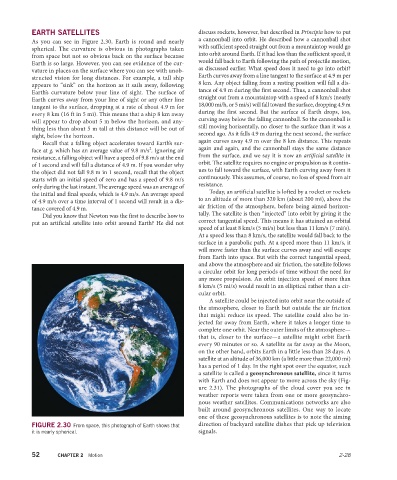
                   As you can see in Figure 2.30, Earth is round and nearly   a cannonball into orbit. He described how a cannonball shot
                   spherical. The curvature is obvious in photographs taken   with sufficient speed straight out from a mountaintop would go
                   from space but not so obvious back on the surface because   into orbit around Earth. If it had less than the sufficient speed, it
                   Earth is so large. However, you can see evidence of the cur-  would fall back to Earth following the path of projectile motion,
                   vature in places on the surface where you can see with unob-  as discussed earlier. What speed does it need to go into orbit?
                   structed vision for long distances. For example, a tall ship   Earth curves away from a line tangent to the surface at 4.9 m per
                   appears to “sink” on the horizon as it sails away, following   8 km. Any object falling from a resting position will fall a dis-
                   Earth’s curvature below your line of sight. The surface of   tance of 4.9 m during the first second. Thus, a cannonball shot
                   Earth curves away from your line of sight or any other line   straight out from a mountaintop with a speed of 8 km/s (nearly
                   tangent to the surface, dropping at a rate of about 4.9 m for   18,000 mi/h, or 5 mi/s) will fall toward the surface, dropping  4.9 m
                   every 8 km (16 ft in 5 mi). This means that a ship 8 km away   during the first second. But the surface of Earth drops, too,
                   will appear to drop about 5 m below the horizon, and any-  curving away below the falling cannonball. So the cannonball is
                   thing less than about 5 m tall at this distance will be out of   still moving horizontally, no closer to the surface than it was a
                   sight, below the horizon.                              second ago. As it falls 4.9 m during the next second, the surface
                      Recall that a falling object accelerates toward Earth’s sur-  again curves away 4.9 m over the 8 km distance. This repeats
                                                          2
                   face at g, which has an average value of 9.8 m/s . Ignoring air   again and again, and the cannonball stays the same distance
                   resistance, a falling object will have a speed of 9.8 m/s at the end   from the surface, and we say it is now an artificial satellite in
                   of 1 second and will fall a distance of 4.9 m. If you wonder why     orbit. The satellite requires no engine or propulsion as it contin-
                   the object did not fall 9.8 m in 1 second, recall that the object   ues to fall toward the surface, with Earth curving away from it
                   starts with an initial speed of zero and has a speed of 9.8 m/s   continuously. This assumes, of course, no loss of speed from air
                   only  during the last instant. The average speed was an average of   resistance.
                   the initial and final speeds, which is 4.9 m/s. An average speed      Today, an artificial satellite is lofted by a  rocket or rockets
                   of 4.9 m/s over a time interval of 1 second will result in a dis-  to an altitude of more than 320 km (about 200 mi), above the
                   tance covered of 4.9 m.                                air friction of the atmosphere, before being aimed horizon-
                      Did you know that Newton was the first to describe how to   tally. The satellite is then “injected” into orbit by giving it the
                   put an artificial satellite into orbit around Earth? He did not   correct tangential speed. This means it has attained an orbital
                                                                          speed of at least 8 km/s (5 mi/s) but less than 11 km/s (7 mi/s).
                                                                          At a speed less than 8 km/s, the satellite would fall back to the
                                                                          surface in a parabolic path. At a speed more than 11 km/s, it
                                                                          will move faster than the surface curves away and will escape
                                                                          from Earth into space. But with the correct tangential speed,
                                                                          and above the atmosphere and air friction, the satellite follows
                                                                          a circular orbit for long periods of time without the need for
                                                                          any more propulsion. An orbit injection speed of more than
                                                                          8 km/s (5 mi/s) would  result in an elliptical rather than a cir-
                                                                          cular orbit.
                                                                             A satellite could be injected into orbit near the outside of
                                                                          the atmosphere, closer to Earth but outside the air friction
                                                                          that might reduce its speed. The satellite could also be in-
                                                                          jected far away from Earth, where it takes a longer time to
                                                                          complete one orbit. Near the outer limits of the atmosphere—
                                                                          that is, closer to the surface—a satellite might orbit Earth
                                                                            every 90 minutes or so. A satellite as far away as the Moon,
                                                                          on the other hand, orbits Earth in a little less than 28 days. A
                                                                          satellite at an altitude of 36,000 km (a little more than  22,000 mi)
                                                                          has a period of 1 day. In the right spot over the equator, such
                                                                          a satellite is called a geosynchronous satellite, since it turns
                                                                          with Earth and does not appear to move across the sky (Fig-
                                                                          ure 2.31). The photographs of the cloud cover you see in
                                                                          weather reports were taken from one or more geosynchro-
                                                                          nous weather satellites. Communications networks are also
                                                                          built around geosynchronous satellites. One way to locate
                                                                          one of these geosynchronous satellites is to note the aiming
                   FIGURE 2.30  From space, this photograph of Earth shows that   direction of backyard satellite dishes that pick up television
                   it is nearly  spherical.                               signals.


                   52      CHAPTER 2 Motion                                                                             2-28

