Page 73 - 9780077418427.pdf
P. 73

/Users/user-f465/Desktop
          tiL12214_ch02_025-060.indd Page 50  9/1/10  9:55 PM user-f465
          tiL12214_ch02_025-060.indd Page 50  9/1/10  9:55 PM user-f465                                                 /Users/user-f465/Desktop


                                                                                       _

                                                                                       m 1 m 2
                                                                                   F = G
                                                                                         d 2
                              m 1                      m 2                                    –11   2  2
                                                                                      (6.67 × 10  N·m /kg )(60.0 kg)(60.0 kg)
                                                                                      ____

                                    F             F                                 =                   2
                                                                                                  (1.00 m)
                                                                                                             2
                                                                                                         N·m ·kg
                                                                                                         _     2


                                                                                                        3 _

                                                                                             –11
                                                                                    = (6.67 × 10 )(3.60 × 10 )      kg 2
                                                                                                            m 2
                                                                                                  2 _
                                                                                                      2)
                                                                                                    (
                                                                                                     1
                                                                                             –7

                                                                                    = 2.40 × 10  (N·m )
                                                                                                     m
                                           d                                                 –7 N·m 2
                                                                                              _

                                                                                    = 2.40 × 10
                                                                                               m 2
                                                                                              –7
                                                                                    =   2.40 × 10 N
                                                                                              –7
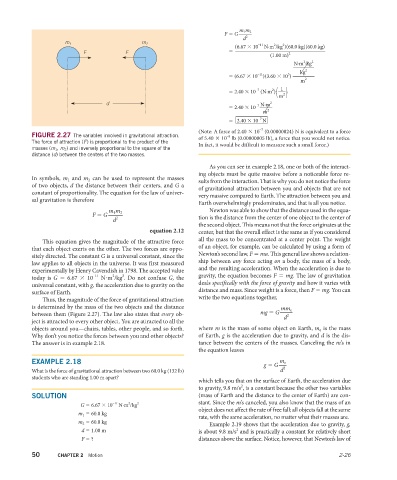
                                                                          (Note: A force of 2.40 × 10  (0.00000024) N is equivalent to a force
                   FIGURE 2.27  The variables involved in gravitational attraction.   of 5.40 × 10  lb (0.00000005 lb), a force that you would not notice.
                                                                                   –8
                   The force of attraction (F ) is proportional to the product of the   In fact, it would be difficult to measure such a small force.)
                   masses (m 1 , m 2 ) and inversely proportional to the square of the
                   distance (d) between the centers of the two masses.
                                                                             As you can see in example 2.18, one or both of the interact-
                                                                          ing objects must be quite massive before a noticeable force re-
                   In symbols,  m 1  and  m 2  can be used to represent the masses
                                                                          sults from the interaction. That is why you do not notice the force
                   of two objects, d the distance between their centers, and G a
                                                                          of gravitational attraction between you and objects that are not
                   constant of proportionality. The equation for the law of univer-
                                                                          very massive compared to Earth. The attraction between you and
                   sal gravitation is therefore
                                                                          Earth overwhelmingly predominates, and that is all you notice.
                                            _                                Newton was able to show that the distance used in the equa-
                                            m 1 m 2

                                       F = G      2                       tion is the distance from the center of one object to the center of
                                              d
                                                                          the second object. This means not that the force originates at the
                                                          equation 2.12   center, but that the overall effect is the same as if you considered
                                                                          all the mass to be concentrated at a center point. The weight
                      This equation gives the magnitude of the attractive force
                                                                          of an object, for example, can be calculated by using a form of
                   that each object exerts on the other. The two forces are oppo-
                                                                          Newton’s second law, F = ma. This general law shows a relation-
                   sitely directed. The constant G is a universal constant, since the
                                                                          ship between any force acting on a body, the mass of a body,
                   law applies to all objects in the universe. It was first measured
                                                                          and the resulting acceleration. When the acceleration is due to
                     experimentally by Henry Cavendish in 1798. The accepted value
                                       –11
                                             2
                                                 2
                   today is G = 6.67 × 10  N⋅m /kg . Do not confuse G, the   gravity, the equation becomes F = mg. The law of gravitation
                                                                          deals specifically with the force of gravity and how it varies with
                   universal constant, with g, the acceleration due to gravity on the
                                                                          distance and mass. Since weight is a force, then F = mg. You can
                   surface of Earth.
                                                                          write the two equations  together,
                      Thus, the magnitude of the force of gravitational attraction
                   is determined by the mass of the two objects and the distance                     _
                                                                                                     mm e

                   between them (Figure 2.27). The law also states that every ob-             mg = G     2
                                                                                                      d
                   ject is attracted to every other object. You are attracted to all the
                   objects around you—chairs, tables, other people, and so forth.   where m is the mass of some object on Earth, m e  is the mass
                   Why don’t you  notice the forces between you and other objects?   of Earth, g is the acceleration due to gravity, and d is the dis-
                   The answer is in  example 2.18.                        tance between the centers of the masses. Canceling the m’s in
                                                                          the equation leaves
                                                                                                     m e _
                   EXAMPLE 2.18                                                                 g = G

                   What is the force of gravitational attraction between two 60.0 kg (132 lb)        d 2
                   students who are standing 1.00 m apart?
                                                                          which tells you that on the surface of Earth, the acceleration due
                                                                                        2
                                                                          to gravity, 9.8 m/s , is a constant because the other two variables
                   SOLUTION                                               (mass of Earth and the distance to the center of Earth) are con-
                                                   2
                                   G = 6.67 × 10 –11  N·m /kg 2           stant. Since the m’s canceled, you also know that the mass of an
                                                                          object does not affect the rate of free fall; all objects fall at the same
                                  m 1  = 60.0 kg
                                                                          rate, with the same acceleration, no matter what their masses are.
                                  m 2  = 60.0 kg
                                                                             Example 2.19 shows that the acceleration due to gravity, g,
                                                                                      2
                                   d = 1.00 m                             is about 9.8 m/s  and is practically a constant for relatively short
                                   F = ?                                  distances above the surface. Notice, however, that  Newton’s law of
                   50      CHAPTER 2 Motion                                                                             2-26
   68   69   70   71   72   73   74   75   76   77   78