


Page 70 - 9780077418427.pdf
P. 70
/Users/user-f465/Desktop
tiL12214_ch02_025-060.indd Page 47 9/1/10 9:55 PM user-f465
tiL12214_ch02_025-060.indd Page 47 9/1/10 9:55 PM user-f465 /Users/user-f465/Desktop
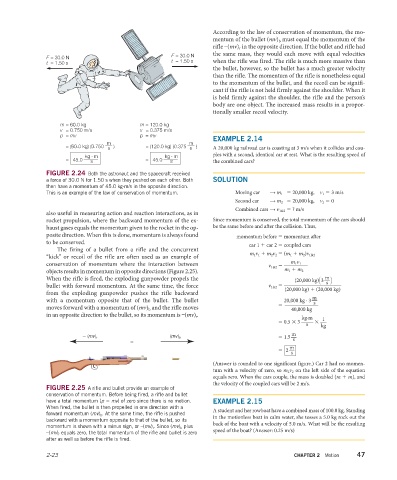
According to the law of conservation of momentum, the mo-
mentum of the bullet (mv) b must equal the momentum of the
rifle –(mv) r in the opposite direction. If the bullet and rifle had
the same mass, they would each move with equal velocities
F = 30.0 N
F = 30.0 N
t = 1.50 s t = 1.50 s when the rifle was fired. The rifle is much more massive than
the bullet, however, so the bullet has a much greater velocity
than the rifle. The momentum of the rifle is nonetheless equal
to the momentum of the bullet, and the recoil can be signifi-
cant if the rifle is not held firmly against the shoulder. When it
is held firmly against the shoulder, the rifle and the person’s
body are one object. The increased mass results in a propor-
tionally smaller recoil velocity.
m = 60.0 kg m = 120.0 kg
v = 0.750 m/s v = 0.375 m/s
p = mv p = mv
EXAMPLE 2.14
m m
= (60.0 kg) (0.750 ) = (120.0 kg) (0.375 ) A 20,000 kg railroad car is coasting at 3 m/s when it collides and cou-
s
s
kg • m kg • m ples with a second, identical car at rest. What is the resulting speed of
= 45.0 s = 45.0 s the combined cars?
FIGURE 2.24 Both the astronaut and the spacecraft received
a force of 30.0 N for 1.50 s when they pushed on each other. Both SOLUTION
then have a momentum of 45.0 kg·m/s in the opposite direction.
This is an example of the law of conservation of momentum. Moving car → m 1 = 20,000 kg, v 1 = 3 m/s
Second car → m 2 = 20,000 kg, v 2 = 0
Combined cars → v 1&2 = ? m/s
also useful in measuring action and reaction interactions, as in
rocket propulsion, where the backward momentum of the ex- Since momentum is conserved, the total momentum of the cars should
haust gases equals the momentum given to the rocket in the op- be the same before and after the collision. Thus,
posite direction. When this is done, momentum is always found momentum before = momentum after
to be conserved.
car 1 + car 2 = coupled cars
The firing of a bullet from a rifle and the concurrent
“kick” or recoil of the rifle are often used as an example of m 1 v 1 + m 2 v 2 = (m 1 + m 2 )v 1&2
conservation of momentum where the interaction between v 1&2 = _
m 1 v 1
objects results in momentum in opposite directions ( Figure 2.25). m 1 + m 2
m _
When the rifle is fired, the exploding gunpowder propels the (20,000 kg)( 3 )
s
bullet with forward momentum. At the same time, the force v 1&2 = ___
(20,000 kg) + (20,000 kg)
from the exploding gunpowder pushes the rifle backward
m _
with a momentum opposite that of the bullet. The bullet 20,000 kg · 3
__
s
moves forward with a momentum of (mv) b and the rifle moves = 40,000 kg
in an opposite direction to the bullet, so its momentum is –(mv) r . kg·m
1
×
= 0.5 × 3 _ _
s
kg
m _
(mv) r (mv) b = 1.5
s
m _
= 2
s
(Answer is rounded to one significant figure.) Car 2 had no momen-
tum with a velocity of zero, so m 2 v 2 on the left side of the equation
equals zero. When the cars couple, the mass is doubled (m + m), and
the velocity of the coupled cars will be 2 m/s.
FIGURE 2.25 A rifle and bullet provide an example of
conservation of momentum. Before being fired, a rifle and bullet
have a total momentum (p = mv) of zero since there is no motion. EXAMPLE 2.15
When fired, the bullet is then propelled in one direction with a A student and her rowboat have a combined mass of 100.0 kg. Standing
forward momentum (mv) b . At the same time, the rifle is pushed
in the motionless boat in calm water, she tosses a 5.0 kg rock out the
backward with a momentum opposite to that of the bullet, so its
momentum is shown with a minus sign, or –(mv) r . Since (mv) b plus back of the boat with a velocity of 5.0 m/s. What will be the resulting
speed of the boat? (Answer: 0.25 m/s)
–(mv) r equals zero, the total momentum of the rifle and bullet is zero
after as well as before the rifle is fired.
2-23 CHAPTER 2 Motion 47

