Page 72 - 9780077418427.pdf
P. 72

/Users/user-f465/Desktop
          tiL12214_ch02_025-060.indd Page 49  9/1/10  9:55 PM user-f465
          tiL12214_ch02_025-060.indd Page 49  9/1/10  9:55 PM user-f465                                                 /Users/user-f465/Desktop


                                           Circular path
                                                                               SOLUTION
                                                                                                            _  2
                                                                                                            mv

                                                                                        m = 0.25 kg      F =
                                                                                                             r
                                                                                        r = 0.5 m           __           2
                                                                                                            (0.25 kg)(2.0 m/s)

                                                                                        v = 2.0 m/s       =      0.5 m
                                                                                        F = ?                          2  2
                                           Radius (r )                                                      __
                                                                                                            (0.25 kg)(4.0 m /s )
                                                                                                          =
                                                                                                                 0.5 m
                                                                 Velocity                                   (0.25)(4.0) kg·m 2
                                                                                                                            1
                                                                                                           =   _ _ _


                                                                                                                        ×


                                                                                                               0.5    s 2   m
                             Centripetal                                                                         2
                                                                                                             kg·m
                             force                                                                           _
                                                                                                          = 2
                                                                                                              m·s 2
                                                                                                             kg·m
                                                                                                             _

                                                                                                          = 2      2
                                                                                                               s
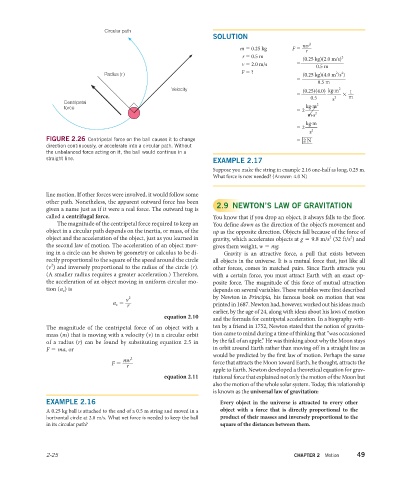
                       FIGURE 2.26  Centripetal force on the ball causes it to change                     =  2 N
                       direction continuously, or accelerate into a circular path. Without
                       the unbalanced force acting on it, the ball would continue in a
                       straight line.
                                                                               EXAMPLE 2.17
                                                                               Suppose you make the string in example 2.16 one-half as long, 0.25 m.
                                                                               What force is now needed? (Answer: 4.0 N)
                       line  motion. If other forces were involved, it would follow some
                       other path. Nonetheless, the apparent outward force has been   2.9  NEWTON’S LAW OF GRAVITATION
                       given a name just as if it were a real force. The outward tug is
                       called a centrifugal force.                             You know that if you drop an object, it always falls to the floor.
                           The magnitude of the centripetal force required to keep an   You define down as the direction of the object’s movement and
                       object in a circular path depends on the inertia, or mass, of the   up as the opposite direction. Objects fall because of the force of
                       object and the acceleration of the object, just as you learned in   gravity, which accelerates objects at g = 9.8 m/s  (32 ft/s ) and
                                                                                                                     2
                                                                                                                            2
                       the second law of motion. The acceleration of an object mov-  gives them weight, w = mg.
                       ing in a circle can be shown by geometry or calculus to be di-     Gravity is an attractive force, a pull that exists between
                       rectly proportional to the square of the speed around the circle   all objects in the universe. It is a mutual force that, just like all
                         2
                       (v ) and inversely proportional to the radius of the circle (r).   other forces, comes in matched pairs. Since Earth attracts you
                       (A smaller radius requires a greater acceleration.) Therefore,   with a certain force, you must attract Earth with an  exact op-
                       the acceleration of an object moving in uniform circular mo-  posite force. The magnitude of this force of mutual  attraction
                       tion (a c ) is                                          depends on several variables. These variables were first described
                                                   2
                                                  v _
                                              a c  =                           by Newton in  Principia, his famous book on motion that was


                                                  r                            printed in 1687. Newton had, however, worked out his ideas much
                                                                               earlier, by the age of 24, along with ideas about his laws of motion
                                                                equation 2.10
                                                                               and the formula for centripetal acceleration. In a biography writ-
                       The magnitude of the centripetal force of an object with a   ten by a friend in 1752, Newton stated that the notion of gravita-
                       mass (m) that is moving with a velocity (v) in a circular orbit   tion came to mind during a time of  thinking that “was occasioned
                       of a radius (r) can be found by substituting equation 2.5 in   by the fall of an apple.” He was thinking about why the Moon stays
                       F = ma, or                                              in orbit around Earth rather than moving off in a straight line as
                                                                               would be predicted by the first law of motion. Perhaps the same
                                                 _ 2
                                                 mv

                                             F =                               force that attracts the Moon toward Earth, he thought, attracts the
                                                  r
                                                                               apple to Earth. Newton developed a theoretical equation for grav-
                                                               equation 2.11   itational force that explained not only the motion of the Moon but
                                                                               also the motion of the whole solar system. Today, this relationship
                                                                               is known as the universal law of  gravitation:
                       EXAMPLE 2.16                                              Every object in the universe is attracted to every other
                       A 0.25 kg ball is attached to the end of a 0.5 m string and moved in a   object with a force that is directly proportional to the
                       horizontal circle at 2.0 m/s. What net force is needed to keep the ball   product of their masses and inversely proportional to the
                       in its circular path?                                     square of the  distances between them.
                       2-25                                                                               CHAPTER 2  Motion   49
   67   68   69   70   71   72   73   74   75   76   77