


Page 74 - 9780077418427.pdf
P. 74
/Users/user-f465/Desktop
tiL12214_ch02_025-060.indd Page 51 9/1/10 9:55 PM user-f465
tiL12214_ch02_025-060.indd Page 51 9/1/10 9:55 PM user-f465 /Users/user-f465/Desktop
Moon
Distance Value of g Mass Weight A
above surface
20,000 mi 1 ft/s 2 70.0 kg 4.7 lb
2
(38,400 km) (0.3 m/s ) (21 N) B
16,000 mi 1.3 ft/s 2 70.0 kg 6.3 lb
(25,600 km) (0.4 m/s ) (28 N)
2
Earth
12,000 mi 2 ft/s 2 70.0 kg 9.5 lb
2
(19,200 km) (0.6 m/s ) (42 N)
8,000 mi 3.6 ft/s 2 70.0 kg 17 lb
2
(12,800 km) (1.1 m/s ) (77 N)
4,000 mi 7.9 ft/s 2 70.0 kg 37 lb
(6,400 km) (2.4 m/s ) (168 N)
2
0 mi 32 ft/s 2 70.0 kg 154 lb
2
(0 km) (9.80 m/s ) (686 N)
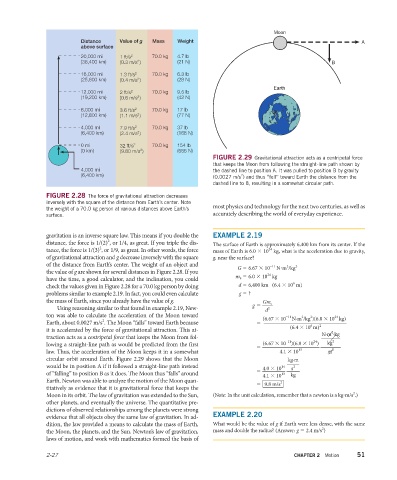
FIGURE 2.29 Gravitational attraction acts as a centripetal force
that keeps the Moon from following the straight-line path shown by
4,000 mi the dashed line to position A. It was pulled to position B by gravity
(6,400 km) (0.0027 m/s ) and thus “fell” toward Earth the distance from the
2
dashed line to B, resulting in a somewhat circular path.
FIGURE 2.28 The force of gravitational attraction decreases
inversely with the square of the distance from Earth’s center. Note
the weight of a 70.0 kg person at various distances above Earth’s most physics and technology for the next two centuries, as well as
surface. accurately describing the world of everyday experience.
gravitation is an inverse square law. This means if you double the EXAMPLE 2.19
2
distance, the force is 1/(2) , or 1/4, as great . If you triple the dis- The surface of Earth is approximately 6,400 km from its center. If the
2
24
tance, the force is 1/(3) , or 1/9, as great. In other words, the force mass of Earth is 6.0 × 10 kg, what is the acceleration due to gravity,
of gravitational attraction and g decrease inversely with the square g, near the surface?
of the distance from Earth’s center. The weight of an object and –11 2 2
G = 6.67 × 10 N⋅m /kg
the value of g are shown for several distances in Figure 2.28. If you 24
m e = 6.0 × 10 kg
have the time, a good calculator, and the inclination, you could 6
check the values given in Figure 2.28 for a 70.0 kg person by doing d = 6,400 km (6.4 × 10 m)
problems similar to example 2.19. In fact, you could even calculate g = ?
the mass of Earth, since you already have the value of g. _
Gm e
g =
Using reasoning similar to that found in example 2.19, New- d 2
ton was able to calculate the acceleration of the Moon toward (6.67 × 10 –11 N·m /kg )(6.0 × 10 kg)
2
2
24
2
Earth, about 0.0027 m/s . The Moon “falls” toward Earth because = ____
6
2
(6.4 × 10 m)
it is accelerated by the force of gravitational attraction. This at- 2
N·m ·kg
traction acts as a centripetal force that keeps the Moon from fol- _
2
24
–11
kg
(6.67 × 10 )(6.0 × 10 )
lowing a straight-line path as would be predicted from the first ___ _
=
law. Thus, the acceleration of the Moon keeps it in a somewhat 4.1 × 10 13 m 2
circular orbit around Earth. Figure 2.29 shows that the Moon _
kg·m
would be in position A if it followed a straight-line path instead _ s 2
14
4.0 × 10 _
of “falling” to position B as it does. The Moon thus “falls” around = 13
kg
4.1 × 10
Earth. Newton was able to analyze the motion of the Moon quan- 2
= 9.8 m/s
titatively as evidence that it is gravitational force that keeps the
2
Moon in its orbit. The law of gravitation was extended to the Sun, (Note: In the unit calculation, remember that a newton is a kg⋅m/s .)
other planets, and eventually the universe. The quantitative pre-
dictions of observed relationships among the planets were strong
evidence that all objects obey the same law of gravitation. In ad- EXAMPLE 2.20
dition, the law provided a means to calculate the mass of Earth, What would be the value of g if Earth were less dense, with the same
2
the Moon, the planets, and the Sun. Newton’s law of gravitation, mass and double the radius? (Answer: g = 2.4 m/s )
laws of motion, and work with mathematics formed the basis of
2-27 CHAPTER 2 Motion 51

