


Page 93 - 9780077418427.pdf
P. 93
/Users/user-f465/Desktop
          tiL12214_ch03_061-084.indd Page Sec3:70  9/1/10  9:33 PM user-f465
          tiL12214_ch03_061-084.indd Page Sec3:70  9/1/10  9:33 PM user-f465                                            /Users/user-f465/Desktop


                                                                          kinetic energy, so it has the ability to do work. An object with
                                                                          potential energy has energy of position, and it, too, has the abil-
                                                                          ity to do work. You could say that energy fl owed into and out
                                                                          of an object during the entire process. The following energy
                                                  d
                                                             F            scheme is intended to give an overall conceptual picture of en-
                                                          d               ergy flow. Use it to develop a broad view of energy. You will
                                                      F
                                                                          learn the details later throughout the course.
                                  Inertia                    Gravity
                      A                                  B
                                                                          ENERGY FORMS
                                                                          Energy comes in various forms, and different terms are used to dis-
                                                                          tinguish one form from another. Although energy comes in various
                                                                          forms, this does not mean that there are different kinds of  energy.
                        d                                        d
                                                                          The forms are the result of the more common fundamental  forces—
                          F                                       F       gravitational, electromagnetic, and nuclear—and objects that are
                                                                          interacting. Energy can be categorized into five forms: (1) mechani-
                                                                          cal, (2) chemical, (3) radiant, (4) electrical, and (5) nuclear. The
                              Friction                  Shape of spring
                                                                          following is a brief discussion of each of the five forms of energy.
                   C                                  D
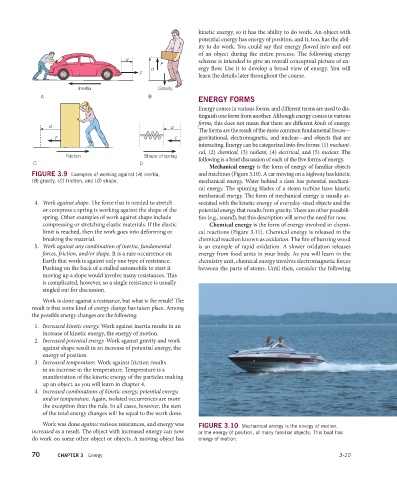
                                                                             Mechanical energy is the form of energy of familiar objects
                   FIGURE 3.9  Examples of working against (A) inertia,   and machines (Figure 3.10). A car moving on a highway has  kinetic
                   (B) gravity, (C) friction, and (D) shape.              mechanical energy. Water behind a dam has potential mechani-
                                                                          cal energy. The spinning blades of a steam turbine have kinetic
                                                                          mechanical energy. The form of mechanical energy is usually as-

                     4.  Work against shape. The force that is needed to stretch   sociated with the kinetic energy of everyday-sized objects and the
                      or  compress a spring is working against the shape of the   potential energy that results from gravity. There are other possibili-
                      spring. Other examples of work against shape include   ties (e.g., sound), but this description will serve the need for now.
                      compressing or stretching elastic materials. If the elastic   Chemical energy is the form of energy involved in chemi-
                      limit is reached, then the work goes into deforming or   cal reactions (Figure 3.11). Chemical energy is released in the
                      breaking the material.                              chemical reaction known as oxidation. The fire of burning wood
                     5.   Work against any combination of inertia, fundamental   is an  example of rapid oxidation. A slower oxidation releases
                      forces,  friction, and/or shape. It is a rare occurrence on   energy from food units in your body. As you will learn in the
                      Earth that work is against only one type of resistance.   chemistry unit, chemical energy involves electromagnetic forces
                      Pushing on the back of a stalled automobile to start it   between the parts of atoms. Until then, consider the following
                      moving up a slope would  involve many resistances. Th is
                      is complicated, however, so a  single resistance is usually
                      singled out for discussion.
                      Work is done against a resistance, but what is the result? The
                   result is that some kind of energy change has taken place. Among
                   the possible energy changes are the following:

                     1.   Increased kinetic energy. Work against inertia results in an

                        increase of kinetic energy, the energy of motion.
                     2.   Increased potential energy. Work against gravity and work
                      against shape result in an increase of potential energy, the
                      energy of  position.
                     3.    Increased temperature. Work against friction results
                      in an  increase in the temperature. Temperature is a
                      manifestation of the kinetic energy of the particles making
                      up an object, as you will learn in chapter 4.
                     4.   Increased combinations of kinetic energy, potential energy,

                      and/or temperature. Again, isolated occurrences are more
                      the exception than the rule. In all cases, however, the sum
                      of the total energy changes will be equal to the work done.
                      Work was done against various resistances, and energy was   FIGURE 3.10  Mechanical energy is the energy of motion,
                   increased as a result. The object with increased energy can now   or the energy of position, of many familiar objects. This boat has
                   do work on some other object or objects. A moving  object has   energy of motion.

                   70      CHAPTER 3 Energy                                                                             3-10

