


Page 286 - HOW TO PROVE IT: A Structured Approach, Second Edition
P. 286
P1: Oyk/
                   0521861241c06  CB996/Velleman  October 20, 2005  1:8  0 521 86124 1  Char Count= 0


                                   272                  Mathematical Induction
                                     We’ll use induction in our proof, and because we’re only interested in pos-
                                   itive n, the base case will be n = 1. In this case we have a 2 × 2 grid with
                                   one square removed, and this can clearly be covered with one L-shaped tile.
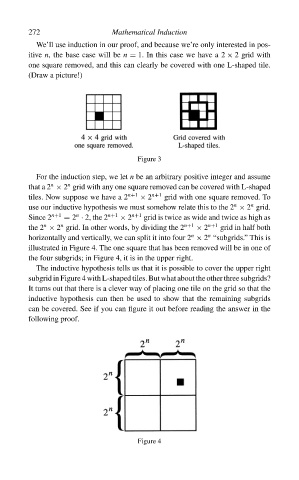
                                   (Draw a picture!)


                                                              Figure 3

                                     For the induction step, we let n be an arbitrary positive integer and assume
                                        n
                                             n
                                   that a 2 × 2 grid with any one square removed can be covered with L-shaped
                                   tiles. Now suppose we have a 2 n+1  × 2 n+1  grid with one square removed. To
                                                                                           n
                                                                                       n
                                   use our inductive hypothesis we must somehow relate this to the 2 × 2 grid.
                                               n
                                   Since 2 n+1  = 2 · 2, the 2 n+1  × 2 n+1  grid is twice as wide and twice as high as
                                           n
                                       n
                                   the 2 × 2 grid. In other words, by dividing the 2 n+1  × 2 n+1  grid in half both
                                                                            n
                                                                                n
                                   horizontally and vertically, we can split it into four 2 × 2 “subgrids.” This is
                                   illustrated in Figure 4. The one square that has been removed will be in one of
                                   the four subgrids; in Figure 4, it is in the upper right.
                                     The inductive hypothesis tells us that it is possible to cover the upper right
                                   subgrid in Figure 4 with L-shaped tiles. But what about the other three subgrids?
                                   It turns out that there is a clever way of placing one tile on the grid so that the
                                   inductive hypothesis can then be used to show that the remaining subgrids
                                   can be covered. See if you can figure it out before reading the answer in the
                                   following proof.


                                                              Figure 4

