


Page 29 - HOW TO PROVE IT: A Structured Approach, Second Edition
P. 29
P1: PIG/
                   0521861241c01  CB996/Velleman  October 19, 2005  23:46  0 521 86124 1  Char Count= 0


                                                      Truth Tables                      15


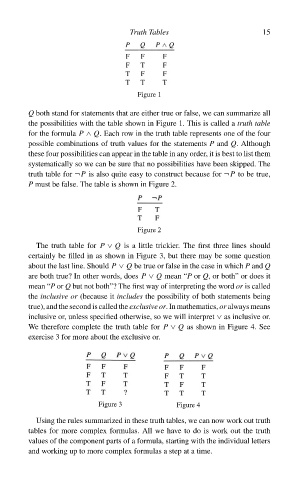
                                                        Figure 1

                            Q both stand for statements that are either true or false, we can summarize all
                            the possibilities with the table shown in Figure 1. This is called a truth table
                            for the formula P ∧ Q. Each row in the truth table represents one of the four
                            possible combinations of truth values for the statements P and Q. Although
                            these four possibilities can appear in the table in any order, it is best to list them
                            systematically so we can be sure that no possibilities have been skipped. The
                            truth table for ¬P is also quite easy to construct because for ¬P to be true,
                            P must be false. The table is shown in Figure 2.


                                                        Figure 2

                              The truth table for P ∨ Q is a little trickier. The first three lines should
                            certainly be filled in as shown in Figure 3, but there may be some question
                            about the last line. Should P ∨ Q be true or false in the case in which P and Q
                            are both true? In other words, does P ∨ Q mean “P or Q, or both” or does it
                            mean “P or Q but not both”? The first way of interpreting the word or is called
                            the inclusive or (because it includes the possibility of both statements being
                            true), and the second is called the exclusive or. In mathematics, or always means
                            inclusive or, unless specified otherwise, so we will interpret ∨ as inclusive or.
                            We therefore complete the truth table for P ∨ Q as shown in Figure 4. See
                            exercise 3 for more about the exclusive or.


                                              Figure 3            Figure 4

                              Using the rules summarized in these truth tables, we can now work out truth
                            tables for more complex formulas. All we have to do is work out the truth
                            values of the component parts of a formula, starting with the individual letters
                            and working up to more complex formulas a step at a time.

