


Page 31 - HOW TO PROVE IT: A Structured Approach, Second Edition
P. 31
P1: PIG/
                   0521861241c01  CB996/Velleman  October 19, 2005  23:46  0 521 86124 1  Char Count= 0


                                                      Truth Tables                      17
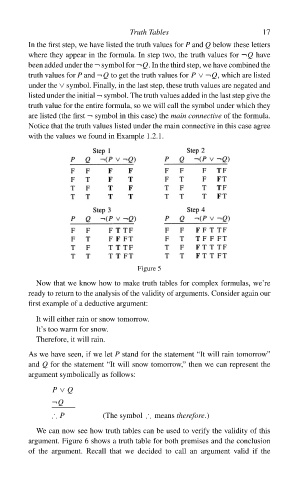
                            In the first step, we have listed the truth values for P and Q below these letters
                            where they appear in the formula. In step two, the truth values for ¬Q have
                            been added under the ¬ symbol for ¬Q. In the third step, we have combined the
                            truth values for P and ¬Q to get the truth values for P ∨¬Q, which are listed
                            under the ∨ symbol. Finally, in the last step, these truth values are negated and
                            listed under the initial ¬ symbol. The truth values added in the last step give the
                            truth value for the entire formula, so we will call the symbol under which they
                            are listed (the first ¬ symbol in this case) the main connective of the formula.
                            Notice that the truth values listed under the main connective in this case agree
                            with the values we found in Example 1.2.1.


                                                        Figure 5

                              Now that we know how to make truth tables for complex formulas, we’re
                            ready to return to the analysis of the validity of arguments. Consider again our
                            first example of a deductive argument:

                              It will either rain or snow tomorrow.
                              It’s too warm for snow.
                              Therefore, it will rain.
                            As we have seen, if we let P stand for the statement “It will rain tomorrow”
                            and Q for the statement “It will snow tomorrow,” then we can represent the
                            argument symbolically as follows:

                                  P ∨ Q
                                  ¬Q
                                  ∴ P          (The symbol ∴ means therefore.)
                              We can now see how truth tables can be used to verify the validity of this
                            argument. Figure 6 shows a truth table for both premises and the conclusion
                            of the argument. Recall that we decided to call an argument valid if the

