


Page 32 - HOW TO PROVE IT: A Structured Approach, Second Edition
P. 32
P1: PIG/
                   0521861241c01  CB996/Velleman  October 19, 2005  23:46  0 521 86124 1  Char Count= 0


                                   18                      Sentential Logic
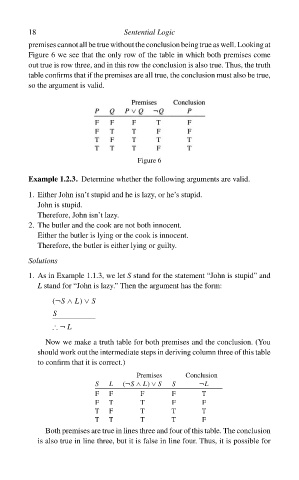
                                   premises cannot all be true without the conclusion being true as well. Looking at
                                   Figure 6 we see that the only row of the table in which both premises come
                                   out true is row three, and in this row the conclusion is also true. Thus, the truth
                                   table confirms that if the premises are all true, the conclusion must also be true,
                                   so the argument is valid.


                                                              Figure 6

                                   Example 1.2.3. Determine whether the following arguments are valid.

                                   1. Either John isn’t stupid and he is lazy, or he’s stupid.
                                     John is stupid.
                                     Therefore, John isn’t lazy.
                                   2. The butler and the cook are not both innocent.
                                     Either the butler is lying or the cook is innocent.
                                     Therefore, the butler is either lying or guilty.
                                   Solutions
                                   1. As in Example 1.1.3, we let S stand for the statement “John is stupid” and
                                     L stand for “John is lazy.” Then the argument has the form:

                                         (¬S ∧ L) ∨ S
                                         S

                                         ∴ ¬ L
                                       Now we make a truth table for both premises and the conclusion. (You
                                     should work out the intermediate steps in deriving column three of this table
                                     to confirm that it is correct.)
                                                              Premises     Conclusion
                                                    S  L   (¬S ∧ L) ∨ S  S    ¬L
                                                    F  F       F       F       T
                                                    F  T       T       F       F
                                                    T  F       T       T       T
                                                    T  T       T       T       F
                                       Both premises are true in lines three and four of this table. The conclusion
                                     is also true in line three, but it is false in line four. Thus, it is possible for

