


Page 33 - HOW TO PROVE IT: A Structured Approach, Second Edition
P. 33
P1: PIG/
                   0521861241c01  CB996/Velleman  October 19, 2005  23:46  0 521 86124 1  Char Count= 0


                                                      Truth Tables                      19
                              both premises to be true and the conclusion false, so the argument is invalid.
                              In fact, the table shows us exactly why the argument is invalid. The problem
                              occurs in the fourth line of the table, in which S and L are both true – in other
                              words, John is both stupid and lazy. Thus, if John is both stupid and lazy,
                              then both premises will be true but the conclusion will be false, so it would
                              be a mistake to infer that the conclusion must be true from the assumption
                              that the premises are true.
                            2. Let B stand for the statement “The butler is innocent,” C for the statement
                              “The cook is innocent,” and L for the statement “The butler is lying.” Then
                              the argument has the form:

                                  ¬(B ∧ C)
                                  L ∨ C
                                  ∴ L ∨¬B

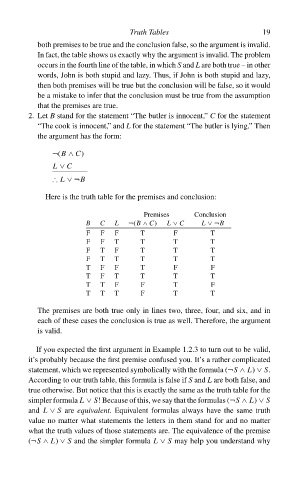
                                Here is the truth table for the premises and conclusion:

                                                         Premises     Conclusion
                                           B  C   L   ¬(B ∧ C)  L ∨ C   L ∨¬B
                                           F  F   F      T       F         T
                                           F  F   T      T       T         T
                                           F  T   F      T       T         T
                                           F  T   T      T       T         T
                                           T  F   F      T       F         F
                                           T  F   T      T       T         T
                                           T  T   F      F       T         F
                                           T  T   T      F       T         T

                              The premises are both true only in lines two, three, four, and six, and in
                              each of these cases the conclusion is true as well. Therefore, the argument
                              is valid.

                              If you expected the first argument in Example 1.2.3 to turn out to be valid,
                            it’s probably because the first premise confused you. It’s a rather complicated
                            statement, which we represented symbolically with the formula (¬S ∧ L) ∨ S.
                            According to our truth table, this formula is false if S and L are both false, and
                            true otherwise. But notice that this is exactly the same as the truth table for the
                            simpler formula L ∨ S! Because of this, we say that the formulas (¬S ∧ L) ∨ S
                            and L ∨ S are equivalent. Equivalent formulas always have the same truth
                            value no matter what statements the letters in them stand for and no matter
                            what the truth values of those statements are. The equivalence of the premise
                            (¬S ∧ L) ∨ S and the simpler formula L ∨ S may help you understand why

