


Page 298 - HOW TO PROVE IT: A Structured Approach, Second Edition
P. 298
P1: Oyk/
                   0521861241c06  CB996/Velleman  October 20, 2005  1:8  0 521 86124 1  Char Count= 0


                                   284                  Mathematical Induction
                                   Scratch work
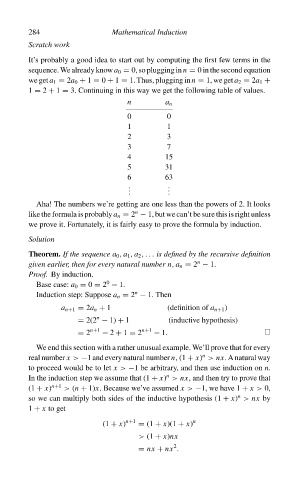
                                   It’s probably a good idea to start out by computing the first few terms in the
                                   sequence. We already know a 0 = 0, so plugging in n = 0 in the second equation
                                   we get a 1 = 2a 0 + 1 = 0 + 1 = 1. Thus, plugging in n = 1, we get a 2 = 2a 1 +
                                   1 = 2 + 1 = 3. Continuing in this way we get the following table of values.
                                                            n         a n
                                                            0         0
                                                            1         1
                                                            2         3
                                                            3         7
                                                            4        15
                                                            5        31
                                                            6        63
                                                            .         .
                                                            . .       . .
                                     Aha! The numbers we’re getting are one less than the powers of 2. It looks
                                                              n
                                   like the formula is probably a n = 2 − 1, but we can’t be sure this is right unless
                                   we prove it. Fortunately, it is fairly easy to prove the formula by induction.

                                   Solution
                                   Theorem. If the sequence a 0 , a 1 , a 2 ,... is defined by the recursive definition
                                                                              n
                                   given earlier, then for every natural number n, a n = 2 − 1.
                                   Proof. By induction.
                                                       0
                                     Base case: a 0 = 0 = 2 − 1.
                                                              n
                                     Induction step: Suppose a n = 2 − 1. Then
                                           a n+1 = 2a n + 1           (definition of a n+1 )
                                                    n
                                               = 2(2 − 1) + 1         (inductive hypothesis)
                                               = 2 n+1  − 2 + 1 = 2 n+1  − 1.
                                     We end this section with a rather unusual example. We’ll prove that for every
                                                                               n
                                   real number x > −1 and every natural number n, (1 + x) > nx. A natural way
                                   to proceed would be to let x > −1 be arbitrary, and then use induction on n.
                                                                      n
                                   In the induction step we assume that (1 + x) > nx, and then try to prove that
                                   (1 + x) n+1  > (n + 1)x. Because we’ve assumed x > −1, we have 1 + x > 0,
                                                                                        n
                                   so we can multiply both sides of the inductive hypothesis (1 + x) > nx by
                                   1 + x to get
                                                      (1 + x) n+1  = (1 + x)(1 + x) n
                                                               > (1 + x)nx
                                                                        2
                                                               = nx + nx .

