


Page 296 - HOW TO PROVE IT: A Structured Approach, Second Edition
P. 296
P1: Oyk/
                   0521861241c06  CB996/Velleman  October 20, 2005  1:8  0 521 86124 1  Char Count= 0


                                   282                  Mathematical Induction
                                   we take n = m as the base for our recursion:
                                                   m

                                                     a i = a m ;
                                                  i=m
                                                                n+1     n

                                                  for every n ≥ m,  a i =  a i + a n+1 .
                                                                i=m    i=m
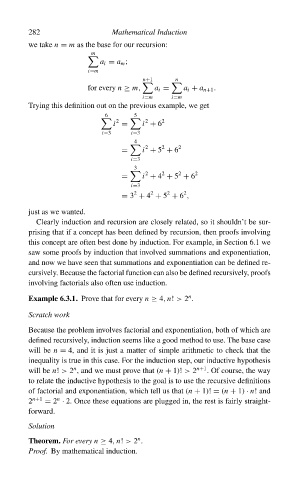
                                   Trying this definition out on the previous example, we get
                                                      6       5

                                                         2      2    2
                                                        i =     i + 6
                                                     i=3     i=3
                                                              4
                                                                2    2   2
                                                          =     i + 5 + 6
                                                             i=3
                                                              3
                                                                2    2   2   2
                                                          =     i + 4 + 5 + 6
                                                             i=3
                                                                  2
                                                              2
                                                                          2
                                                                      2
                                                          = 3 + 4 + 5 + 6 ,
                                   just as we wanted.
                                     Clearly induction and recursion are closely related, so it shouldn’t be sur-
                                   prising that if a concept has been defined by recursion, then proofs involving
                                   this concept are often best done by induction. For example, in Section 6.1 we
                                   saw some proofs by induction that involved summations and exponentiation,
                                   and now we have seen that summations and exponentiation can be defined re-
                                   cursively. Because the factorial function can also be defined recursively, proofs
                                   involving factorials also often use induction.
                                                                           n
                                   Example 6.3.1. Prove that for every n ≥ 4, n! > 2 .
                                   Scratch work
                                   Because the problem involves factorial and exponentiation, both of which are
                                   defined recursively, induction seems like a good method to use. The base case
                                   will be n = 4, and it is just a matter of simple arithmetic to check that the
                                   inequality is true in this case. For the induction step, our inductive hypothesis
                                              n
                                   will be n! > 2 , and we must prove that (n + 1)! > 2 n+1 . Of course, the way
                                   to relate the inductive hypothesis to the goal is to use the recursive definitions
                                   of factorial and exponentiation, which tell us that (n + 1)! = (n + 1) · n! and
                                          n
                                   2 n+1  = 2 · 2. Once these equations are plugged in, the rest is fairly straight-
                                   forward.
                                   Solution

                                                              n
                                   Theorem. For every n ≥ 4, n! > 2 .
                                   Proof. By mathematical induction.

