


Page 300 - HOW TO PROVE IT: A Structured Approach, Second Edition
P. 300
P1: Oyk/
                   0521861241c06  CB996/Velleman  October 20, 2005  1:8  0 521 86124 1  Char Count= 0


                                   286                  Mathematical Induction
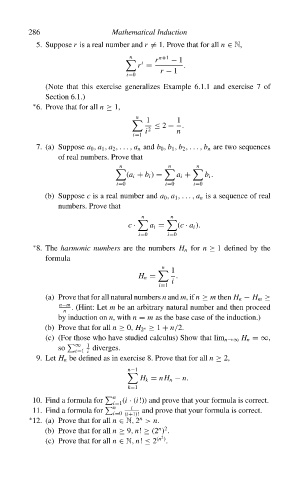
                                     5. Suppose r is a real number and r  = 1. Prove that for all n ∈ N,
                                                            n       n+1
                                                                   r   − 1
                                                               i
                                                              r =         .
                                                                    r − 1
                                                            i=0
                                       (Note that this exercise generalizes Example 6.1.1 and exercise 7 of
                                       Section 6.1.)
                                     6. Prove that for all n ≥ 1,
                                    ∗
                                                              n
                                                                 1      1
                                                                   ≤ 2 −  .
                                                                i 2     n
                                                             i=1
                                     7. (a) Suppose a 0 , a 1 , a 2 ,..., a n and b 0 , b 1 , b 2 ,..., b n are two sequences
                                          of real numbers. Prove that
                                                          n           n      n

                                                            (a i + b i ) =  a i +  b i .
                                                         i=0          i=0    i=0
                                       (b) Suppose c is a real number and a 0 , a 1 ,..., a n is a sequence of real
                                          numbers. Prove that
                                                               n       n

                                                            c ·   a i =  (c · a i ).
                                                               i=0    i=0
                                     8. The harmonic numbers are the numbers H n for n ≥ 1 defined by the
                                    ∗
                                       formula
                                                                     n
                                                                       1
                                                               H n =    .
                                                                       i
                                                                    i=1
                                       (a) Prove that for all natural numbers n and m,if n ≥ m then H n − H m ≥
                                          n−m  . (Hint: Let m be an arbitrary natural number and then proceed
                                            n
                                          by induction on n, with n = m as the base case of the induction.)
                                       (b) Prove that for all n ≥ 0, H 2 ≥ 1 + n/2.
                                                                n
                                       (c) (For those who have studied calculus) Show that lim n→∞ H n =∞,
                                          so    ∞  1  diverges.
                                               i=1 i
                                     9. Let H n be defined as in exercise 8. Prove that for all n ≥ 2,
                                                            n−1

                                                               H k = nH n − n.
                                                            k=1
                                                        n
                                    10. Find a formula for  (i · (i!)) and prove that your formula is correct.

                                                        i=1
                                    11. Find a formula for    n  i  and prove that your formula is correct.
                                                        i=0 (i+1)!
                                    12. (a) Prove that for all n ∈ N, 2 > n.
                                   ∗                           n
                                                                    n 2
                                       (b) Prove that for all n ≥ 9, n! ≥ (2 ) .
                                                                     2
                                       (c) Prove that for all n ∈ N, n! ≤ 2 (n ) .

