


Page 299 - HOW TO PROVE IT: A Structured Approach, Second Edition
P. 299
P1: Oyk/
                   0521861241c06  CB996/Velleman  October 20, 2005  1:8  0 521 86124 1  Char Count= 0


                                                       Recursion                       285
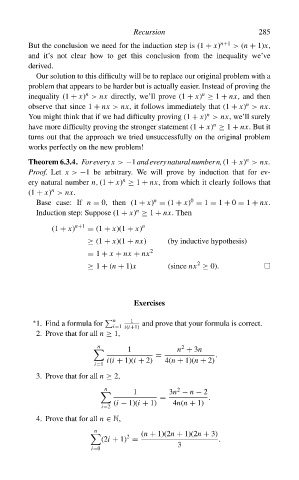
                            But the conclusion we need for the induction step is (1 + x) n+1  > (n + 1)x,
                            and it’s not clear how to get this conclusion from the inequality we’ve
                            derived.
                              Our solution to this difficulty will be to replace our original problem with a
                            problem that appears to be harder but is actually easier. Instead of proving the
                                                                        n
                                           n
                            inequality (1 + x) > nx directly, we’ll prove (1 + x) ≥ 1 + nx, and then
                                                                                    n
                            observe that since 1 + nx > nx, it follows immediately that (1 + x) > nx.
                                                                          n
                            You might think that if we had difficulty proving (1 + x) > nx, we’ll surely
                                                                           n
                            have more difficulty proving the stronger statement (1 + x) ≥ 1 + nx. But it
                            turns out that the approach we tried unsuccessfully on the original problem
                            works perfectly on the new problem!
                                                                                    n
                            Theorem 6.3.4. Forevery x > −1andeverynaturalnumbern,(1 + x) > nx.
                            Proof. Let x > −1 be arbitrary. We will prove by induction that for ev-
                                                    n
                            ery natural number n, (1 + x) ≥ 1 + nx, from which it clearly follows that
                                  n
                            (1 + x) > nx.
                                                                     0
                                                            n
                              Base case: If n = 0, then (1 + x) = (1 + x) = 1 = 1 + 0 = 1 + nx.
                                                        n
                              Induction step: Suppose (1 + x) ≥ 1 + nx. Then
                                  (1 + x) n+1  = (1 + x)(1 + x) n
                                           ≥ (1 + x)(1 + nx)    (by inductive hypothesis)
                                           = 1 + x + nx + nx 2
                                                                       2
                                           ≥ 1 + (n + 1)x       (since nx ≥ 0).


                                                       Exercises

                                                  n   1

                              1. Find a formula for      and prove that your formula is correct.
                             ∗
                                                  i=1 i(i+1)
                              2. Prove that for all n ≥ 1,
                                              n                    2
                                                     1            n + 3n
                                                            =               .
                                                i(i + 1)(i + 2)  4(n + 1)(n + 2)
                                             i=1
                              3. Prove that for all n ≥ 2,
                                               n                  2
                                                       1        3n − n − 2
                                                              =           .
                                                  (i − 1)(i + 1)  4n(n + 1)
                                               i=2
                              4. Prove that for all n ∈ N,
                                             n
                                                         (n + 1)(2n + 1)(2n + 3)
                                                     2
                                               (2i + 1) =                    .
                                                                  3
                                            i=0

