


Page 375 - HOW TO PROVE IT: A Structured Approach, Second Edition
P. 375
P1: PIG/
                   0521861241apx01  CB996/Velleman  October 20, 2005  2:56  0 521 86124 1  Char Count= 0


                                         Appendix 1: Solutions to Selected Exercises   361
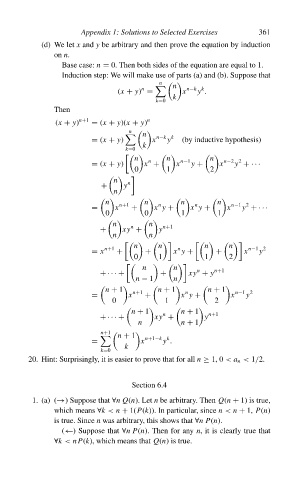
                               (d) We let x and y be arbitrary and then prove the equation by induction
                                   on n.
                                     Base case: n = 0. Then both sides of the equation are equal to 1.
                                     Induction step: We will make use of parts (a) and (b). Suppose that
                                                             n
                                                         n       n  n−k k
                                                   (x + y) =       x   y .
                                                                 k
                                                             k=0
                                   Then
                                   (x + y) n+1  = (x + y)(x + y) n
                                                      n
                                                         n   n−k k
                                            = (x + y)       x  y   (by inductive hypothesis)
                                                         k
                                                     k=0

                                                       n   n   n   n−1    n   n−2 2
                                            = (x + y)     x +     x   y +    x   y +· · ·
                                                       0       1          2

                                                  n  n
                                               +    y
                                                  n
                                                n  n+1    n  n     n  n     n   n−1 2

                                            =     x   +     x y +    x y +     x   y +· · ·
                                                0         0        1        1
                                                  n   n    n  n+1

                                              +     xy +     y
                                                  n        n

                                                       n     n    n      n     n    n−1 2
                                               n+1
                                            = x    +      +      x y +      +      x   y
                                                       0     1           1     2
                                                         n       n     n   n+1

                                              +··· +          +      xy + y
                                                       n − 1     n

                                                n + 1  n+1   n + 1  n     n + 1  n−1 2
                                            =         x   +        x y +        x   y
                                                 0             1            2
                                                      n + 1   n    n + 1  n+1

                                              +··· +        xy +         y
                                                        n          n + 1
                                              n+1
                                                   n + 1  n+1−k k
                                            =            x    y .
                                                     k
                                              k=0
                            20. Hint: Surprisingly, it is easier to prove that for all n ≥ 1, 0 < a n < 1/2.
                                                      Section 6.4
                             1. (a) (→) Suppose that ∀nQ(n). Let n be arbitrary. Then Q(n + 1) is true,
                                   which means ∀k < n + 1(P(k)). In particular, since n < n + 1, P(n)
                                   is true. Since n was arbitrary, this shows that ∀nP(n).
                                     (←) Suppose that ∀nP(n). Then for any n, it is clearly true that
                                   ∀k < nP(k), which means that Q(n) is true.

