


Page 373 - HOW TO PROVE IT: A Structured Approach, Second Edition
P. 373
P1: PIG/
                   0521861241apx01  CB996/Velleman  October 20, 2005  2:56  0 521 86124 1  Char Count= 0


                                         Appendix 1: Solutions to Selected Exercises   359
                               Then
                                     n+1      n
                                         1       1      1         1      1
                                           =       +        ≤ 2 −   +
                                         i 2     i 2  (n + 1) 2   n   (n + 1) 2
                                     i=1     i=1
                                                                  2
                                                  2
                                                 n + n + 1       n + n          1
                                           = 2 −        2  < 2 −       2  = 2 −    .
                                                 n(n + 1)       n(n + 1)       n + 1
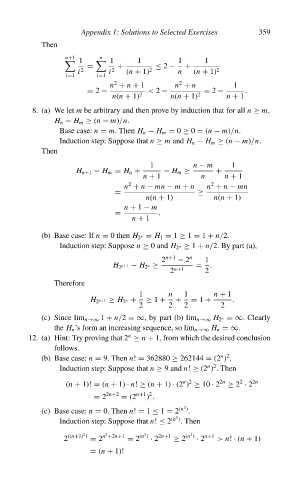
                             8. (a) We let m be arbitrary and then prove by induction that for all n ≥ m,
                                   H n − H m ≥ (n − m)/n.
                                    Base case: n = m. Then H n − H m = 0 ≥ 0 = (n − m)/n.
                                    Induction step: Suppose that n ≥ m and H n − H m ≥ (n − m)/n.
                               Then
                                                           1          n − m     1
                                        H n+1 − H m = H n +   − H m ≥       +
                                                         n + 1          n     n + 1
                                                                           2
                                                      2
                                                    n + n − mn − m + n    n + n − mn
                                                  =                    ≥
                                                          n(n + 1)         n(n + 1)
                                                    n + 1 − m
                                                  =          .
                                                      n + 1
                               (b) Base case: If n = 0 then H 2 = H 1 = 1 ≥ 1 = 1 + n/2.
                                                         n
                                    Induction step: Suppose n ≥ 0 and H 2 ≥ 1 + n/2. By part (a),
                                                                  n
                                                              2 n+1  − 2 n  1
                                                  H 2 n+1 − H 2 ≥  n+1  =  .
                                                          n
                                                                2        2
                                   Therefore
                                                        1       n   1      n + 1
                                                     n
                                            H 2 n+1 ≥ H 2 +  ≥ 1 +  +  = 1 +    .
                                                        2       2   2        2
                               (c) Since lim n→∞ 1 + n/2 =∞, by part (b) lim n→∞ H 2 =∞. Clearly
                                                                             n
                                   the H n ’s form an increasing sequence, so lim n→∞ H n =∞.
                                                     n
                            12. (a) Hint: Try proving that 2 ≥ n + 1, from which the desired conclusion
                                   follows.
                                                                             n 2
                               (b) Base case: n = 9. Then n! = 362880 ≥ 262144 = (2 ) .
                                                                          n 2
                                    Induction step: Suppose that n ≥ 9 and n! ≥ (2 ) . Then
                                                                                  2
                                                                   n 2
                                      (n + 1)! = (n + 1) · n! ≥ (n + 1) · (2 ) ≥ 10 · 2 2n  ≥ 2 · 2 2n
                                             = 2 2n+2  = (2 n+1 2
                                                          ) .
                                                                    2
                               (c) Base case: n = 0. Then n! = 1 ≤ 1 = 2 (n ) .
                                                                  2
                                    Induction step: Suppose that n! ≤ 2 (n ) . Then
                                                                     2
                                          2
                                                2
                                                          2
                                     2 ((n+1) )  = 2 n +2n+1  = 2 (n )  · 2 2n+1  ≥ 2 (n )  · 2 n+1  > n! · (n + 1)
                                            = (n + 1)!

