


Page 57 - HOW TO PROVE IT: A Structured Approach, Second Edition
P. 57
P1: PIG/
                   0521861241c01  CB996/Velleman  October 19, 2005  23:46  0 521 86124 1  Char Count= 0


                                        The Conditional and Biconditional Connectives   43
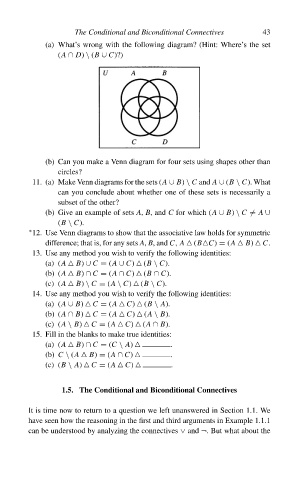
                                (a) What’s wrong with the following diagram? (Hint: Where’s the set
                                    (A ∩ D) \ (B ∪ C)?)


                                (b) Can you make a Venn diagram for four sets using shapes other than
                                    circles?
                             11. (a) Make Venn diagrams for the sets (A ∪ B) \ C and A ∪ (B \ C). What
                                    can you conclude about whether one of these sets is necessarily a
                                    subset of the other?
                                (b) Give an example of sets A, B, and C for which (A ∪ B) \ C  = A ∪
                                    (B \ C).
                            ∗ 12. Use Venn diagrams to show that the associative law holds for symmetric
                                difference; that is, for any sets A, B, and C, A   (B C) = (A   B)   C.
                             13. Use any method you wish to verify the following identities:
                                (a) (A   B) ∪ C = (A ∪ C)   (B \ C).
                                (b) (A   B) ∩ C = (A ∩ C)   (B ∩ C).
                                (c) (A   B) \ C = (A \ C)   (B \ C).
                             14. Use any method you wish to verify the following identities:
                                (a) (A ∪ B)   C = (A   C)   (B \ A).
                                (b) (A ∩ B)   C = (A   C)   (A \ B).
                                (c) (A \ B)   C = (A   C)   (A ∩ B).
                             15. Fill in the blanks to make true identities:
                                (a) (A   B) ∩ C = (C \ A)       .
                                (b) C \ (A   B) = (A ∩ C)       .
                                (c) (B \ A)   C = (A   C)       .


                                     1.5. The Conditional and Biconditional Connectives

                            It is time now to return to a question we left unanswered in Section 1.1. We
                            have seen how the reasoning in the first and third arguments in Example 1.1.1
                            can be understood by analyzing the connectives ∨ and ¬. But what about the

