


Page 59 - HOW TO PROVE IT: A Structured Approach, Second Edition
P. 59
P1: PIG/
                   0521861241c01  CB996/Velleman  October 19, 2005  23:46  0 521 86124 1  Char Count= 0


                                        The Conditional and Biconditional Connectives   45
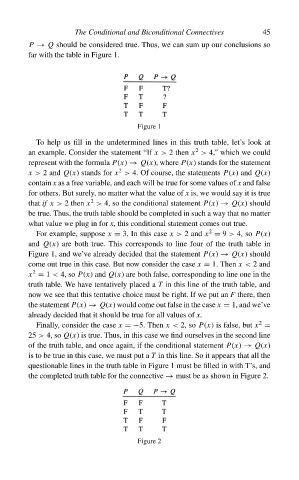
                            P → Q should be considered true. Thus, we can sum up our conclusions so
                            far with the table in Figure 1.


                                                        Figure 1
                              To help us fill in the undetermined lines in this truth table, let’s look at
                                                                       2
                            an example. Consider the statement “If x > 2 then x > 4,” which we could
                            represent with the formula P(x) → Q(x), where P(x) stands for the statement
                                                   2
                            x > 2 and Q(x) stands for x > 4. Of course, the statements P(x) and Q(x)
                            contain x as a free variable, and each will be true for some values of x and false
                            for others. But surely, no matter what the value of x is, we would say it is true
                                            2
                            that if x > 2 then x > 4, so the conditional statement P(x) → Q(x) should
                            be true. Thus, the truth table should be completed in such a way that no matter
                            what value we plug in for x, this conditional statement comes out true.
                                                                          2
                              For example, suppose x = 3. In this case x > 2 and x = 9 > 4, so P(x)
                            and Q(x) are both true. This corresponds to line four of the truth table in
                            Figure 1, and we’ve already decided that the statement P(x) → Q(x) should
                            come out true in this case. But now consider the case x = 1. Then x < 2 and
                             2
                            x = 1 < 4, so P(x) and Q(x) are both false, corresponding to line one in the
                            truth table. We have tentatively placed a T in this line of the truth table, and
                            now we see that this tentative choice must be right. If we put an F there, then
                            the statement P(x) → Q(x) would come out false in the case x = 1, and we’ve
                            already decided that it should be true for all values of x.
                                                                                       2
                              Finally, consider the case x =−5. Then x < 2, so P(x) is false, but x =
                            25 > 4, so Q(x) is true. Thus, in this case we find ourselves in the second line
                            of the truth table, and once again, if the conditional statement P(x) → Q(x)
                            is to be true in this case, we must put a T in this line. So it appears that all the
                            questionable lines in the truth table in Figure 1 must be filled in with T’s, and
                            the completed truth table for the connective → must be as shown in Figure 2.


                                                        Figure 2

