


Page 24 - PRE-U STPM BIOLOGY TERM 1
P. 24
Biology Term 1  STPM  Chapter 2 Structure of Cells and Organelles

                     (iii)  The shape of the nucleolus is usually spherical, but it can be
                          oval and it can change its shape.
                     (iv)  There is usually one nucleolus per nucleus, but in rare cases,
                          there can be two per nucleus.
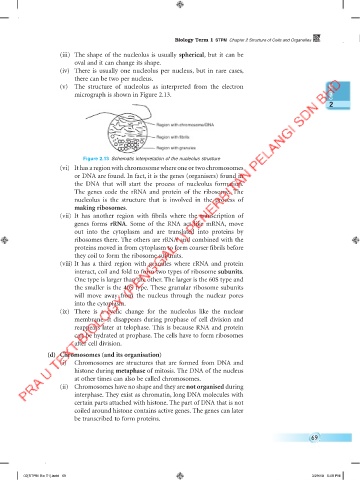
                     (v)  The structure of nucleolus as interpreted from the electron
                          micrograph is shown in Figure 2.13.
                                                                                                              2


                                                     Region with chromosome/DNA
                                                     Region with fibrils
                                                     Region with granules
                             Figure 2.13  Schematic interpretation of the nucleolus structure
                     (vi)  It has a region with chromosome where one or two chromosomes
                          or DNA are found. In fact, it is the genes (organisers) found in
                          the  DNA  that  will  start  the  process  of  nucleolus  formation.
                          The genes code the rRNA and protein of the ribosome. The
                          nucleolus  is  the  structure  that  is  involved  in  the  process  of
                          making ribosomes.
                     (vii)  It has another region with fibrils where the transcription of
                          genes forms  rRNA. Some of the RNA act like mRNA, move
                          out into the cytoplasm and are translated into proteins by
                          ribosomes there. The others are rRNA and combined with the
                          proteins moved in from cytoplasm to form coarser fibrils before
                          they coil to form the ribosome subunits.
                     (viii) It has a third region with granules where rRNA and protein
                          interact, coil and fold to form two types of ribosome subunits.
                          One type is larger than the other. The larger is the 60S type and
                          the smaller is the 40S type. These granular ribosome subunits
                          will move away from the nucleus through the nuclear pores
                          into the cytoplasm.
                     (ix)  There is a cyclic change for the nucleolus like the nuclear
                          membrane. It disappears during prophase of cell division and
                          reappears later at telophase. This is because RNA and protein
                          can be hydrated at prophase. The cells have to form ribosomes
                          after cell division.

                 (d)  Chromosomes (and its organisation)
                     (i)  Chromosomes  are  structures  that  are  formed  from  DNA  and
                          histone during metaphase of mitosis. The DNA of the nucleus
                          at other times can also be called chromosomes.
                     (ii)  Chromosomes have no shape and they are not organised during
                          interphase. They exist as chromatin, long DNA molecules with
                          certain parts attached with histone. The part of DNA that is not
                          coiled around histone contains active genes. The genes can later
                          be transcribed to form proteins.


                                                                                                        69


         02[STPM Bio T1].indd   69                                                                      3/29/18   5:08 PM

