


Page 28 - PRE-U STPM BIOLOGY TERM 1
P. 28
Biology Term 1  STPM  Chapter 2 Structure of Cells and Organelles


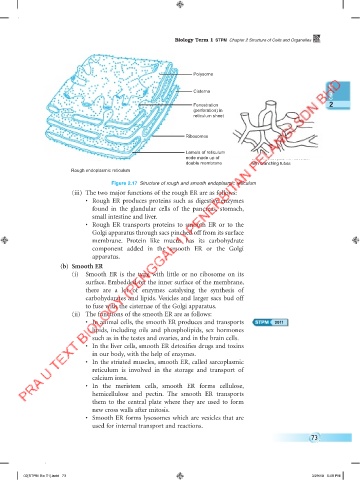
                                                                 Polysome

                                                                 Cisterna

                                                                 Fenestration                                 2
                                                                 (perforation) in
                                                                 reticulum sheet


                                                               Ribosomes

                                                               Lamela of reticulum
                                                               node made up of      Smooth endoplasmic reticulum
                                                               double membrane      with branching tubes
                         Rough endoplasmic reticulum

                                      Figure 2.17  Structure of rough and smooth endoplasmic reticulum
                         (iii)  The two major functions of the rough ER are as follows:
                             •  Rough ER produces proteins such as digestive enzymes
                                found in the glandular cells of the pancreas, stomach,
                                small intestine and liver.
                             •  Rough  ER  transports  proteins  to  smooth  ER  or  to  the
                                Golgi apparatus through sacs pinched off from its surface
                                membrane. Protein like mucus has its carbohydrate
                                component  added  in  the  smooth  ER  or  the  Golgi
                                apparatus.
                     (b)  Smooth ER
                         (i)  Smooth ER is the type with little or no ribosome on its
                             surface. Embedded on the inner surface of the membrane,
                             there are a lot of enzymes catalysing the synthesis of
                             carbohydarates and lipids. Vesicles and larger sacs bud off
                             to fuse with the cisternae of the Golgi apparatus.
                         (ii)  The functions of the smooth ER are as follows:
                             •  In animal cells, the smooth ER produces and transports      2011
                                lipids, including oils and phospholipids, sex hormones
                                such as in the testes and ovaries, and in the brain cells.
                             •  In the liver cells, smooth ER detoxifies drugs and toxins
                                in our body, with the help of enzymes.
                             •  In the striated muscles, smooth ER, called sarcoplasmic
                                reticulum is involved in the storage and transport of
                                calcium ions.
                             •  In  the  meristem  cells,  smooth  ER  forms  cellulose,
                                hemicellulose and pectin. The smooth ER transports
                                them to the central plate where they are used to form
                                new cross walls after mitosis.
                             •  Smooth ER forms lysosomes which are vesicles that are
                                used for internal transport and reactions.

                                                                                                        73


         02[STPM Bio T1].indd   73                                                                      3/29/18   5:08 PM

