


Page 25 - PRE-U STPM BIOLOGY TERM 1
P. 25
Biology Term 1  STPM  Chapter 2 Structure of Cells and Organelles

                                            (iii)  The number of chromosomes per cell ranges from 8 – 100. The
                                                 chromosomes in diploid organisms exist in pairs. For example,
                                                 each human somatic (non-gametic) cell has 46 chromosomes,
                                                 in 23 pairs. In gametes, the number is halved.
                                            (iv)  Homologous chromosomes are identical in structure, though
                                                 not necessarily in allelic constitution.
          2                                 (v)  Maternal chromosomes are the set of chromosomes which
                                                 originates from the mother through the  ovum. Paternal
                                                 chromosomes are the set that originates from the father through
                                                 the spermatozoon.
                                            (vi)  Sex chromosomes determine the sex of the organism. For
                                                 example, females have a pair of homologous X chromosomes
                                                 whereas the males have an X chromosome and a non-
                                                 homologous and much smaller Y chromosome. A gene called
                                                 the t factor in the  Y chromosome determines the formation
                                                 of testes during the formation of the sex organ in the foetus.
                                                 Otherwise, the foetus will be a female.
                                            (vii)  Chromosomes other than the sex chromosomes are called
                                                 autosomes. They are usually in larger numbers. For example,
                                                 the human cells have 22 pairs of autosomes and one pair of sex
                                                 chromosomes.
                                            (viii) The size of the chromosomes  varies  between species. The
                                                 average size of the human chromosome is 6 µm. The largest
                                                 human chromosome is labelled as chromosome 1 and the
                                                 smallest as chromosome 22 and chromosome Y.
                                                 Plants usually have larger chromosomes than animals. Birds and
                                                 fungi are among the organisms with the smallest chromosomes.
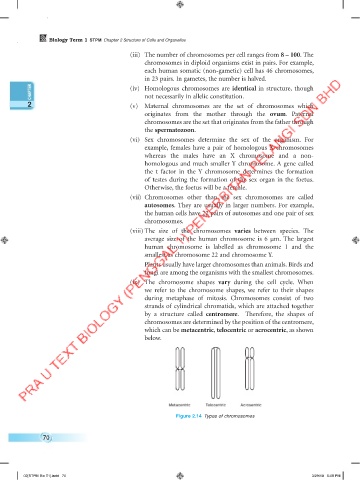
                                            (ix)  The  chromosome  shapes  vary  during  the  cell cycle.  When
                                                 we  refer to the chromosome shapes, we refer to their shapes
                                                 during metaphase of mitosis. Chromosomes consist of two
                                                 strands of cylindrical chromatids, which are attached together
                                                 by  a  structure  called  centromere.    Therefore,  the  shapes  of
                                                 chromosomes are determined by the position of the centromere,
                                                 which can be metacentric, telocentric or acrocentric, as shown
                                                 below.


                                                         Metacentric  Telocentric  Acrosentric
                                                           Figure 2.14  Types of chromosomes


               70


         02[STPM Bio T1].indd   70                                                                      3/29/18   5:08 PM

