


Page 26 - PRE-U STPM BIOLOGY TERM 1
P. 26
Biology Term 1  STPM  Chapter 2 Structure of Cells and Organelles

                     The  centromere is the primary constriction of the chromosome.
                     Besides the centromere, there may be another constriction which
                     is called secondary constriction. Some chromosomes may have
                     secondary constriction. Other chromosomes may be of longer or
                     shorter length. All these determine the shape of chromosomes.


                                                                                                              2


                                 Chromosome with        Chromosome with
                               secondary constriction     extra length
                               Figure 2.15  Two types of abnormal chromosomes
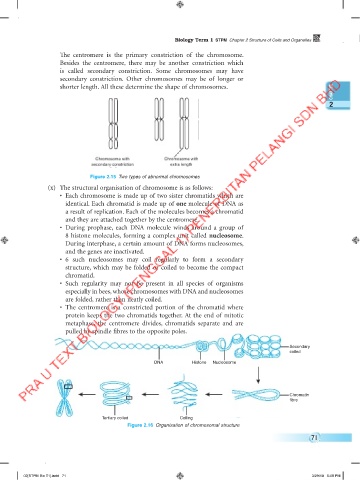
                 (x)  The structural organisation of chromosome is as follows:
                     •  Each chromosome is made up of two sister chromatids which are
                       identical. Each chromatid is made up of one molecule of DNA as
                       a result of replication. Each of the molecules becomes a chromatid
                       and they are attached together by the centromere.
                     •  During  prophase,  each  DNA  molecule  winds  around  a  group  of
                       8 histone molecules, forming a complex unit called nucleosome.
                       During interphase, a certain amount of DNA forms nucleosomes,
                       and the genes are inactivated.
                     •  6  such  nucleosomes  may  coil  regularly  to  form  a  secondary
                       structure, which may be folded or coiled to become the compact
                       chromatid.
                     •  Such  regularity  may  not  be  present  in  all  species  of  organisms
                       especially in bees, whose chromosomes with DNA and nucleosomes
                       are folded, rather than neatly coiled.
                     •  The  centromere  is  a  constricted  portion  of  the  chromatid  where
                       protein keeps the two chromatids together. At the end of mitotic
                       metaphase, the centromere divides, chromatids separate and are
                       pulled by spindle fibres to the opposite poles.

                                                                                                 Secondary
                                                                                                 coiled
                                                    DNA          Histone  Nucleosome


                                                                                                 Chromatin
                                                                                                 fibre


                                   Tertiary coiled           Coiling
                                           Figure 2.16  Organisation of chromosomal structure
                                                                                                        71


         02[STPM Bio T1].indd   71                                                                      3/29/18   5:08 PM

