


Page 30 - PRE-U STPM BIOLOGY TERM 1
P. 30
Biology Term 1  STPM  Chapter 2 Structure of Cells and Organelles

                 12.  The size of these granules vary. These are the ATP synthase enzyme
                     that performs oxidative phosphorylation to produce ATP from ADP
                     and phosphate, in the presence of oxygen.
                 13.  The colloidal interior of the mitochondria contains ribosomes, DNA,
                     RNA and a lot of enzymes, which are involved in the Krebs cycle and
                     the oxidation of fatty acids.
                                                                                                              2
                 14.  The functions of mitochondria are as follows:
                     (a)  Mitochondria carry out Krebs cycle, part of cellular respiration
                         within their matrices.
                     (b)  They carry out oxidation and complete breakdown of fatty acids
                         into carbon dioxide and water to produce ATP.
                     (c)  They carry out oxidation and complete breakdown of  amino
                         acids.
                     (d)  They carry out oxidative phosphorylation, which produces ATP
                         from ADP and phosphate.
                     (e)  They produce their own  proteins from DNA with the help of
                         RNA. The proteins are those required for the oxidative process.
                Golgi apparatus (Dictyosome in plant cells)

                  1.  Golgi apparatus is an organelle consisting of a stack of flattened sacs,   2014
                     which produce vesicles full of secretion for internal or external uses.
                                                                                            2018
                  2.   They are found in large numbers in glandular cells, neurones, muscle
                     tissues, root cap cells and meristems of plants. Their locations within
                     the cell are not fixed. They are formed from ER.
                  3.  There is usually  one of them  per cell. However, there are many
                     in glandular cells and  their number can  increase as  the secretory
                     activities increase. Meristem has more of them per cell.
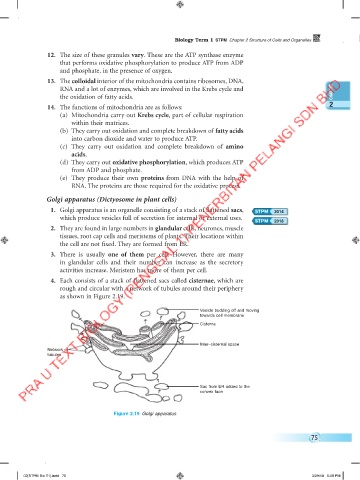
                  4.  Each consists of a stack of flattened sacs called cisternae, which are
                     rough and circular with a network of tubules around their periphery
                     as shown in Figure 2.19.

                                                                   Vesicle budding off and moving
                                                                   towards cell membrane
                                                                   Cisterna


                                                                   Inter–cisternal space
                 Network of
                 tubules


                                                                   Sac from ER added to the
                                                                   convex face


                                       Figure 2.19  Golgi apparatus


                                                                                                        75


         02[STPM Bio T1].indd   75                                                                      3/29/18   5:08 PM

