


Page 32 - PRE-U STPM BIOLOGY TERM 1
P. 32
Biology Term 1  STPM  Chapter 2 Structure of Cells and Organelles

                  7.  Their content is  acidic, homogenous in nature and contain many
                     types of hydrolases. They include proteinase, lipase, carbohydratase,
                     acid nuclease (DNase and RNase) and acid phosphatase.
                  8.  The functions of lysosomes are as follows:
                     (a)  It can digest foreign substances or cells that are endocytosised.
                     (b)  It clips certain bond such as that of thyroglobulin. Thyroglobulin
                         is formed within the follicle of the thyroid gland. When it passes                   2
                         through cells lining the follicle, thyroxin is released from the
                         globulin and emptied into the capillary.
                     (c)  It can carry out autophagy i.e. old or worn out organelles are
                         digested by their digestive enzymes. Red blood cells have their
                         nuclei digested during their course of development in bone
                         marrows.
                     (d)  It exports their enzymes by exocytosis such as in the cartilage by
                         osteoclasts during its development to form bones.
                     (e)  It can carry out autolysis in which the whole cells are digested for
                         rebuilding of new tissue during metamorphorsis. This happens
                         in the tail of the tadpole where the digestion products are used
                         for building lungs and adult skin.

                Ribosomes

                  1.  Ribosomes are small granules where synthesis of proteins occurs.
                  2.  They are found in  all  cells particularly cells that produce a lot of
                     proteins such as the glandular cells of pancreas and liver. Ribosomes
                     are found in the nucleus, free in cytoplasm or in cytoplasm attached
                     to ER, mitochondria and chloroplasts.
                  3.  Their number is  not  fixed. It is found in large numbers in the
                     glandular cell that produces a lot of proteins and its numbers can
                     increase.
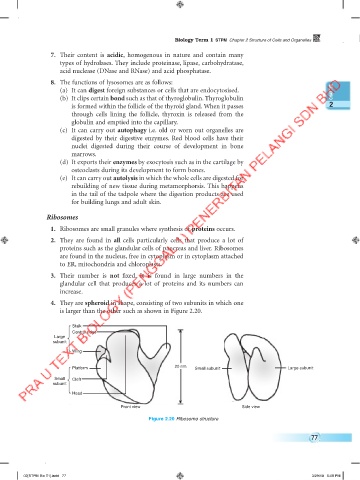
                  4.  They are spheroid in shape, consisting of two subunits in which one
                     is larger than the other such as shown in Figure 2.20.

                         Stalk
                         Central ridge
                   Large
                   subunit
                         Wing


                         Platform                          20 nm  Small subunit                 Large subunit
                   Small  Cleft
                   subunit
                         Head

                                         Front view                              Side view
                                                  Figure 2.20 Ribosome structure


                                                                                                        77


         02[STPM Bio T1].indd   77                                                                      3/29/18   5:08 PM

