


Page 35 - PRE-U STPM BIOLOGY TERM 1
P. 35
Biology Term 1  STPM  Chapter 2 Structure of Cells and Organelles

                                         13.  The functions of chloroplasts are as follows:
                                            (a)  The major function of chloroplast is to carry out photosynthesis
                                                producing organic compounds especially carbohydrates.
                                            (b)  Chloroplasts carry out their functions by using the membranes
                                                of thylakoids and lamellae to  trap lights  and convert them to
                                                chemical energy mainly in the form of  ATP. They carry out
          2                                     photoactivation and photophosphorylation through Calvin cycle.
                                            (c)  The ATP is then used to perform the fixation of carbon dioxide
                                                to become organic compounds in the stroma.
                                            (d)  The DNA and the protein synthetic system in the chloroplasts
                                                produces some of the specific proteins used in photosynthesis.
                                                The chloroplasts still depend on the nucleus to obtain most
                                                proteins within.
                                            (e)  The chloroplast can  divide  especially in their premature
                                                protoplastid stage in the meristem. Mature chloroplasts do divide.
                                        Centrioles (Centrosome)

                                          1.  Centrioles are organelles that assemble spindle fibres in animal cells
                                            but are not found in plant cells.
                                          2.  They are found in all animal cells except the nerve cells. They are also
                                            found in fungal and algal cells.
                                          3.  One pair of centrioles is usually located beside the nucleus.
                                          4.  The two centrioles are cylindrical in shape, arranged perpendicular
                                            to one another as shown in Figure 2.22.


                                                          Figure 2.22  The structure of centrioles
                                          5.  They are small and can be observed as a dot under a light microscope.
                                            Their length is about 0.3-0.4 µm with a diameter of about 0.2 µm.
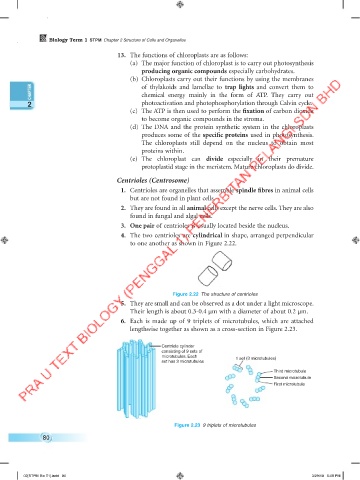
                                          6.  Each is made up of 9 triplets of microtubules, which are  attached
                                            lengthwise together as shown as a cross-section in Figure 2.23.


                                                       Centriole cylinder
                                                       consisting of 9 sets of
                                                       microtubules. Each      1 set (3 microtubules)
                                                       set has 3 microtubules
                                                                                            Third microtubule
                                                                                            Second microtubule
                                                                                            First microtubule


                                                           Figure 2.23  9 triplets of microtubules
               80


         02[STPM Bio T1].indd   80                                                                      3/29/18   5:08 PM

