


Page 36 - PRE-U STPM BIOLOGY TERM 1
P. 36
Biology Term 1  STPM  Chapter 2 Structure of Cells and Organelles

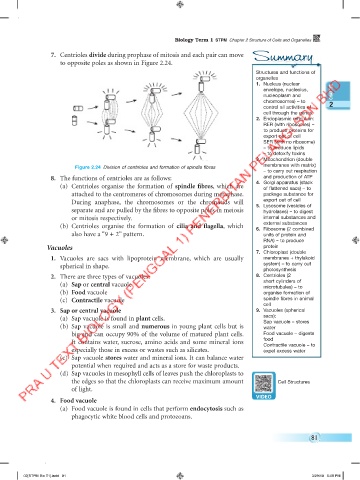
                   7.  Centrioles divide during prophase of mitosis and each pair can move   Summary
                     to opposite poles as shown in Figure 2.24.
                                                                                      Structures and functions of
                                                                                      organelles
                                                                                      1.  Nucleus (nuclear
                                                                                        envelope, nucleolus,
                                                                                        nucleoplasm and
                                                                                        chromosomes) – to     2
                                                                                        control all activities of
                                                                                        cell through the genes.
                                                                                      2.  Endoplasmic reticulum:
                                                                                         RER (with ribosomes) –
                                                                                        to produce proteins for
                                                                                        export out of cell
                                                                                         SER (with no ribosome)
                                                                                        – to produce lipids
                                                                                         – to detoxify toxins
                                                                                      3.  Mitochondrion (double
                                                                                        membranes with matrix)
                          Figure 2.24  Division of centrioles and formation of spindle fibres
                                                                                        – to carry out respiration
                   8.  The functions of centrioles are as follows:                      and production of ATP
                     (a)  Centrioles organise the formation of  spindle fibres, which are   4.  Golgi apparatus (stack
                                                                                        of flattened sacs) – to
                         attached to the centromeres of chromosomes during metaphase.   package substance for
                                                                                        export out of cell
                         During anaphase, the chromosomes or the chromatids will      5.  Lysosome (vesicles of
                         separate and are pulled by the fibres to opposite poles in meiosis   hydrolases) – to digest
                         or mitosis respectively.                                       internal substances and
                     (b)  Centrioles organise the formation of  cilia and flagella, which   external substances
                                                                                      6.  Ribosome (2 combined
                         also have a “9 + 2” pattern.                                   units of protein and
                                                                                        RNA) – to produce
                 Vacuoles                                                               protein
                                                                                      7.  Chloroplast (double
                   1.  Vacuoles are sacs with lipoprotein membrane, which are usually   membranes + thylakoid
                     spherical in shape.                                                system) – to carry out
                                                                                        photosynthesis
                   2.  There are three types of vacuoles:                             8.  Centrioles (2
                     (a)  Sap or central vacuole                                        short cylinders of
                                                                                        microtubules) – to
                     (b)  Food vacuole                                                  organise formation of
                     (c)  Contractile vacuole                                           spindle fibres in animal
                                                                                        cell
                   3.  Sap or central vacuole                                         9.  Vacuoles (spherical
                     (a)  Sap vacuole is found in plant cells.                           sacs):
                                                                                        Sap vacuole – stores
                     (b)  Sap vacuole is small and numerous in young plant cells but is   water
                         big and can occupy 90% of the volume of matured plant cells.      Food vacuole – digests
                         It contains water, sucrose, amino acids and some mineral ions      food
                                                                                        Contractile vacuole – to
                         especially those in excess or wastes such as silicates.        expel excess water
                     (c)  Sap vacuole stores water and mineral ions. It can balance water
                         potential when required and acts as a store for waste products.
                     (d)  Sap vacuoles in mesophyll cells of leaves push the chloroplasts to
                         the edges so that the chloroplasts can receive maximum amount       Cell Structures
                         of light.
                                                                                      VIDEO
                   4.  Food vacuole
                     (a)  Food vacuole is found in cells that perform endocytosis such as
                         phagocytic white blood cells and protozoans.


                                                                                                        81


         02[STPM Bio T1].indd   81                                                                      3/29/18   5:08 PM

