


Page 38 - PRE-U STPM BIOLOGY TERM 1
P. 38
Biology Term 1  STPM  Chapter 2 Structure of Cells and Organelles

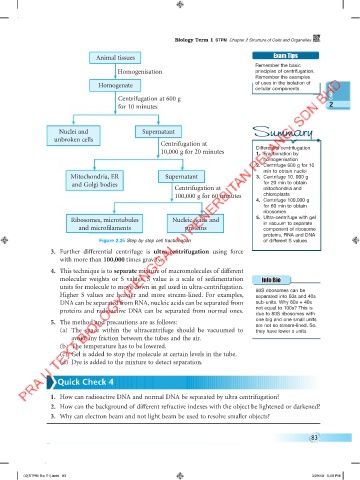
                                 Animal tissues                                             Exam Tips
                                                                                      Remember the basic
                                        Homogenisation                                principles of centrifugation.
                                                                                      Remember the examples
                                  Homogenate                                          of uses in the isolation of
                                                                                      cellular components.
                                        Centrifugation at 600 g
                                        for 10 minutes                                                        2


                     Nuclei and                 Supernatant                          Summary
                   unbroken cells
                                                      Centrifugation at
                                                      10,000 g for 20 minutes         Differential centrifugation
                                                                                      1.  Fractionation by
                                                                                        homogenisation
                                                                                      2.  Centrifuge 600 g for 10
                                                                                        min to obtain nuclei
                        Mitochondria, ER                Supernatant                   3.  Centrifuge 10, 000 g
                         and Golgi bodies                                               for 20 min to obtain
                                                           Centrifugation at            mitochondria and
                                                           100,000 g for 60 minutes     chloroplasts
                                                                                      4.  Centrifuge 100,000 g
                                                                                        for 60 min to obtain
                                                                                        ribosomes
                         Ribosomes, microtubules          Nucleic acids and           5.  Ultra-centrifuge with gel
                                                                                        in vacuum to separate
                           and microfilaments                 proteins                  component of ribosome
                                                                                        proteins, RNA and DNA
                                  Figure 2.25 Step by step cell fractionation           of different S values
                  3.  Further differential centrifuge is  ultra-centrifugation using force
                     with more than 100,000 times gravity.
                  4.  This technique is to separate mixture of macromolecules of different
                     molecular weights or S values. S value is a scale of sedimentation   Info Bio
                     units for molecule to move down in gel used in ultra-centrifugation.
                     Higher S values are heavier and more stream-lined. For examples,   80S ribosomes can be
                                                                                      separated into 60s and 40s
                     DNA can be separated from RNA, nucleic acids can be separated from   sub-units. Why 60s + 40s
                                                                                      not equal to 100s? This is
                     proteins and radioactive DNA can be separated from normal ones.  due to 80S ribosomes with
                                                                                      one big and one small units
                  5.  The method and precautions are as follows:                      are not so stream-lined. So,
                     (a)  The space within the ultracentrifuge should be vacuumed to   they have lower s units.
                         avoid any friction between the tubes and the air.
                     (b)  The temperature has to be lowered.
                     (c)  Gel is added to stop the molecule at certain levels in the tube.
                     (d)  Dye is added to the mixture to detect separation.


                    Quick Check 4

                  1.  How can radioactive DNA and normal DNA be separated by ultra centrifugation?
                  2.  How can the background of different refractive indexes with the object be lightened or darkened?
                  3.  Why can electron beam and not light beam be used to resolve smaller objects?


                                                                                                        83


         02[STPM Bio T1].indd   83                                                                      3/29/18   5:08 PM

