


Page 50 - PRE-U STPM BIOLOGY TERM 1
P. 50
Biology Term 1  STPM  Chapter 2 Structure of Cells and Organelles

                             •  They have ducts that secrete substances.
                             •  There are little capillaries in them.
                             •  They produce liquid with proteins or enzymes.
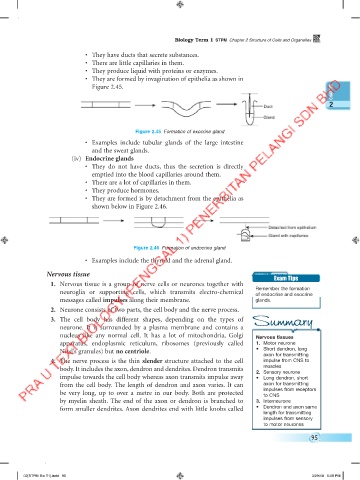
                             •  They are formed by invagination of epithelia as shown in
                               Figure 2.45.


                                                                                                              2
                                                                                        Duct
                                                                                        Gland

                                              Figure 2.45  Formation of exocrine gland
                             •  Examples  include  tubular  glands  of  the  large  intestine
                               and the sweat glands.
                         (iv)  Endocrine glands
                             •  They  do  not  have  ducts,  thus  the  secretion  is  directly
                               emptied into the blood capillaries around them.
                             •  There are a lot of capillaries in them.
                             •  They produce hormones.
                             •  They are formed is by detachment from the epithelia as
                               shown below in Figure 2.46.


                                                                                          Detached from epithelium
                                                                                          Gland with capillaries
                                             Figure 2.46  Formation of endocrine gland
                             •  Examples include the thyroid and the adrenal gland.

                Nervous tissue                                                              2013
                                                                                            Exam Tips
                  1.  Nervous tissue is a group of nerve cells or neurones together with
                                                                                      Remember the formation
                     neuroglia or supporting cells, which transmits electro-chemical   of endocrine and exocrine
                     messages called impulses along their membrane.                   glands.
                  2.  Neurone consists of two parts, the cell body and the nerve process.
                  3.  The  cell  body  has  different shapes,  depending  on  the  types  of   Summary
                     neurone. It is surrounded by a plasma membrane and contains a
                     nucleus like any normal cell. It has a lot of mitochondria, Golgi   Nervous tissues
                     apparatus, endoplasmic reticulum, ribosomes (previously called   1.  Motor neurone
                     Nissl’s granules) but no centriole.                              •  Short dendron, long
                                                                                        axon for transmitting
                  4.  The nerve process is the thin slender structure attached to the cell   impulse from CNS to
                                                                                        muscles
                     body. It includes the axon, dendron and dendrites. Dendron transmits   2.  Sensory neurone
                     impulse towards the cell body whereas axon transmits impulse away   •  Long dendron, short
                     from the cell body. The length of dendron and axon varies. It can   axon for transmitting
                     be very long, up to over a metre in our body. Both are protected   impulses from receptors
                                                                                        to CNS
                     by myelin sheath. The end of the axon or dendron is branched to   3.  Interneurone
                     form smaller dendrites. Axon dendrites end with little knobs called   •  Dendron and axon same
                                                                                        length for transmitting
                                                                                        impulses from sensory
                                                                                        to motor neurones

                                                                                                        95


         02[STPM Bio T1].indd   95                                                                      3/29/18   5:08 PM

