


Page 17 - PRE-U STPM CHEMISTRY TERM 1
P. 17
Chemistry Term 1  STPM
                  5  The first and second ionisation energies correspond to the process:
                                                             –1
                                +
                        C(g) → C (g) + e     ∆H = 1090 kJ mol
                                 2+
                        C (g) → C (g)        ∆H = 2350 kJ mol –1
                         +
                  6  The ionisation energy increases with the number of electrons
                    removed. This is because successive species have ever increasing                            CHAPTER
                     proton    ratio.  This  causes  the  remaining  electrons  to  be  more
                     electron                                                                                  2
                    tightly held by the nucleus.
                  7  The graph shows that there is a gradual increase in the first four   Sucessive ionisation energy
                    ionisation energies. However, there is a very large increase in energy   increases because electrons
                    in removing the fifth electron.                                 are removed from cations
                  8  This suggests that the first four electrons and the fifth electron   of increasing charge.
                    occupy different energy levels or shells.
                  9  The ionisation energies of the last two electrons are very large
                    compared to the first four, suggesting that the last two electrons are
                    closest to the nucleus in energy level or orbit n = 1, while the first
                    four electrons are in the outermost energy level or orbit, n = 2.
                 10  The distribution of the five electrons in the boron atom is:
                           Orbit, n         Principle shell    No. of electrons
                             1                   K                  2
                             2                   L                  3

                 11  A similar study shows that silicon, Si, has the following
                                                          14
                    electronic distribution.
                           Orbit, n         Principle shell    No. of electrons
                             1                   K                  2
                             2                   L                  8
                             3                   M                  4


                     Quick Check 2.3

                  1  Use appropriate equations to represent the following ionisation:
                    (a)  the 5th ionisation energy of sodium.
                    (b)  the 12th ionisation energy of aluminium.

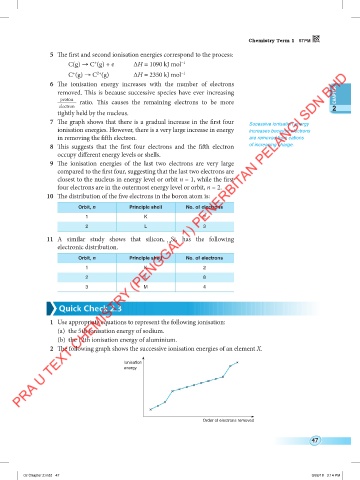
                  2  The following graph shows the successive ionisation energies of an element X.

                                          Ionisation
                                          energy


                                                                    Order of electrons removed

                                                                                                        47


         02 Chapter 2.indd   47                                                                         3/26/18   3:14 PM

