


Page 19 - PRE-U STPM CHEMISTRY TERM 1
P. 19
Chemistry Term 1 STPM
4 The total number of electrons that can occupy any principle shell
2
(with quantum number n) is 2n .
Principle shell n No. of subshells
First, K 1 2
CHAPTER
Second, L 2 8
Third, M 3 18
2
Fourth, N 4 32
5 Further experiments on the line spectra shows that each subshell is
further made up of orbital where the electrons are placed.
6 The number of orbital depends on the type of subshell as shown
below: Energy
d
Subshell No. of orbitals Symbol
s 1 s p
p 3 p , p , p
x y z s
d 5 , d 2
d , d , d , d 2 – y 2
xy yz xz x z Subshell Orbital
7 The three p orbitals have equivalent energies. In other words, they
degenerate. The same goes for the five d orbitals.
Shapes of the Orbitals
1 The concept of orbitals arises from the fact that an electron has dual
nature. It is a particle as well as a wave. Shapes of the
Orbitals
2 As a wave, it extends in all directions in space. VIDEO
3 However, we can define the region in space within which the ‘wave
density’ of a particular electron is maximum.
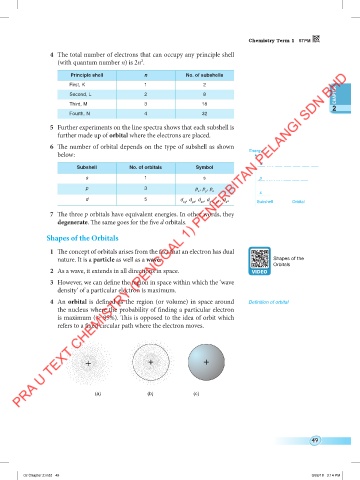
4 An orbital is defined as the region (or volume) in space around Definition of orbital
the nucleus where the probability of finding a particular electron
is maximum ( 95%). This is opposed to the idea of orbit which
refers to a fixed circular path where the electron moves.
(a) (b) (c)
49
02 Chapter 2.indd 49 3/26/18 3:14 PM

